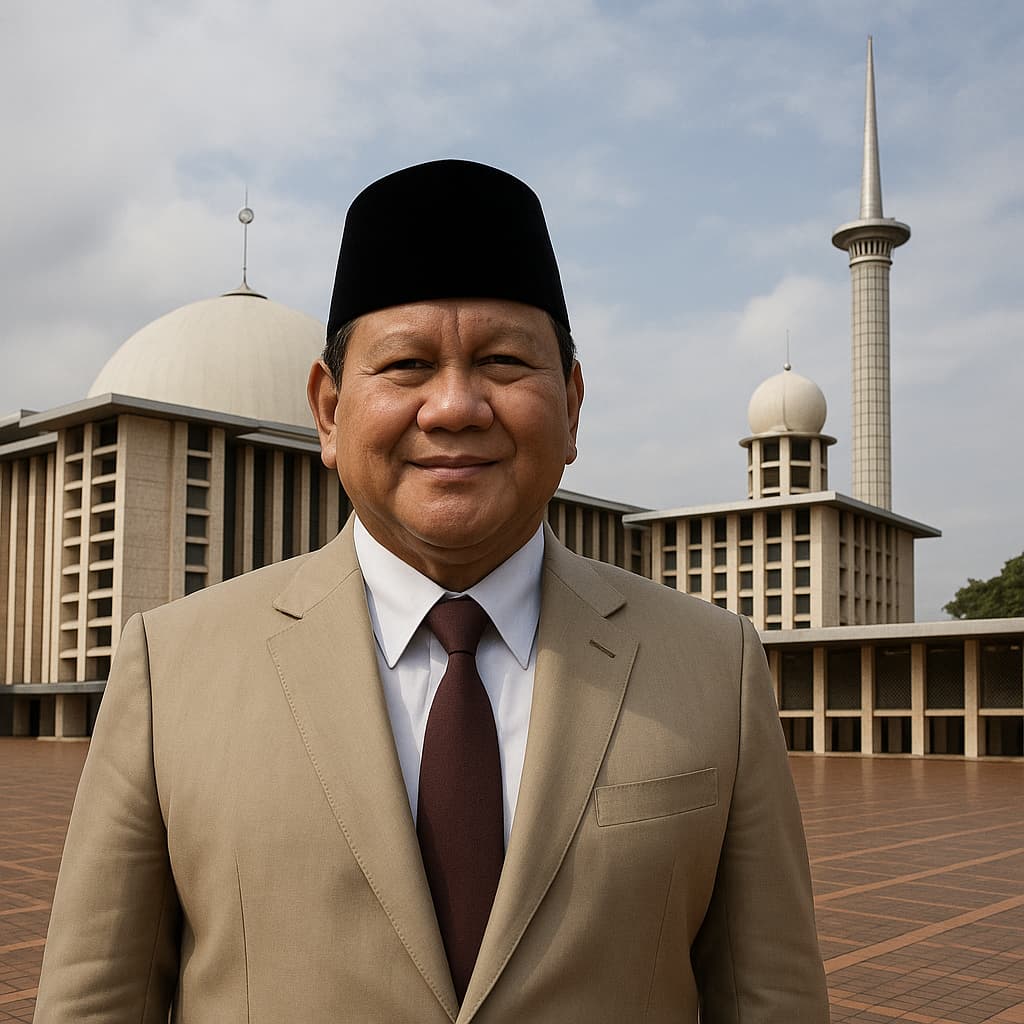
The Indonesian Paradox: President Prabowo Subianto’s Guide to Improving Indonesia Towards the Golden Era of 2045
Author,Jacob Ereste
Freelance Journalist
Prabowo Subianto’s critical analysis of the economic and democratic conditions in Indonesia, written in 2017 under the title “The Indonesian Paradox,” exposes the disparity between Indonesia’s wealth and poverty, a situation that should be created fairly and equitably, at least in terms of minimal welfare, without digging holes and filling holes in the daily lives of Indonesian citizens, who are wallowing in abundance, including wealth held by only a handful.
Prabowo Subianto notes that the majority of national wealth is controlled by the elite, with 66 percent of the wealth controlled by the 10 percent who hold economic and political power.
Therefore, Prabowo Subianto’s work critiques the democratic system in Indonesia, which has been dominated by capitalists. As a result, the struggle between the people and the economic elite is like the Pandavas versus the Kauravas, as capitalists are able to buy people’s votes through money politics.
Tragically, Indonesia’s wealth has spilled overseas, preventing the Indonesian people from enjoying it. He stated at the time that there were 11,000 trillion rupiah belonging to Indonesian individuals and companies stashed abroad, an amount five times larger than Indonesia’s state budget.
Therefore, Prabowo Subianto saw a path to economic independence and self-sufficiency in food, energy, and clean water, although the leaks have not yet been fully plugged, thus revitalizing the Indonesian economy from various sectors that have been suffering from drought and drought. Furthermore, local industries continue to be encouraged to thrive, though they remain hostage to a bureaucracy already contaminated by corruption and always eager to exploit opportunities to enrich themselves by any means possible, including through religious institutions no longer considered sacred and tied to worship. Consequently, the hoped-for added value of utilizing natural resources and creating jobs has not yet been realized until nearly a year into Prabowo Subianto’s presidency with his hardworking Red and White Cabinet, still plagued by the legacy of the previous, highly corrupt regime.
The village-based development championed by Prabowo Subianto in his book “Paradox Indonesia,” which he hoped would become the foundation for national independence, is still struggling and has yet to fully take off, except for a portion of the agricultural sector, which the Indonesian National Police (Polri) is fully utilizing to compensate for its negative image when it was predominantly concentrated in urban areas. Rural-based economic movements can indeed alleviate economic inequality, potentially reducing the frequency of national unrest.
Therefore, this book, which serves as Prabowo Subianto’s graduation thesis for his presidency of the Republic of Indonesia for the 2024-2029 term, can serve as a reference point for proof, especially in confronting the corrupt system and mentality inherited from the previous regime. Therefore, major steps in transformation—reform—or even revolution, if necessary, are needed to break free from the colonial cultural system that diminishes the chivalrous spirit acquired through the distinctive education of the Indonesian National Army, which is resilient and determined to never give up under any circumstances.
A consistent approach—such as initiating cabinet work and providing training for regional government officials—has also been developed at the Military Academy in Magelang. Consequently, the concept for amending the 1945 Constitution contains compelling criticisms demanding immediate revision, particularly regarding Article 33, paragraphs 4 and 5, which Prabowo Subianto believes are the root cause of economic inequality in Indonesia. Therefore, Prabowo Subianto’s call for a return to the original text of the 1945 Constitution, dated August 18, 1945, deserves and deserves support from all elements of the nation who desire change for the better, for justice, and for the prosperity of all Indonesians.
This is the book “Paradox Indonesia,” written by Prabowo Subianto as a guide to successfully improving Indonesia towards the golden era of 2045, which is fast approaching for the Indonesian nation and state to witness and enjoy after a century of independence.**
Banten, July 10, 2025
—