Ambon Conflict and Peace Strategy: From Laskar Jihad to the Maluku Diaspora in the Netherlands
Live Report by Jaya-News.Com Special Contributor ( Part 1 )
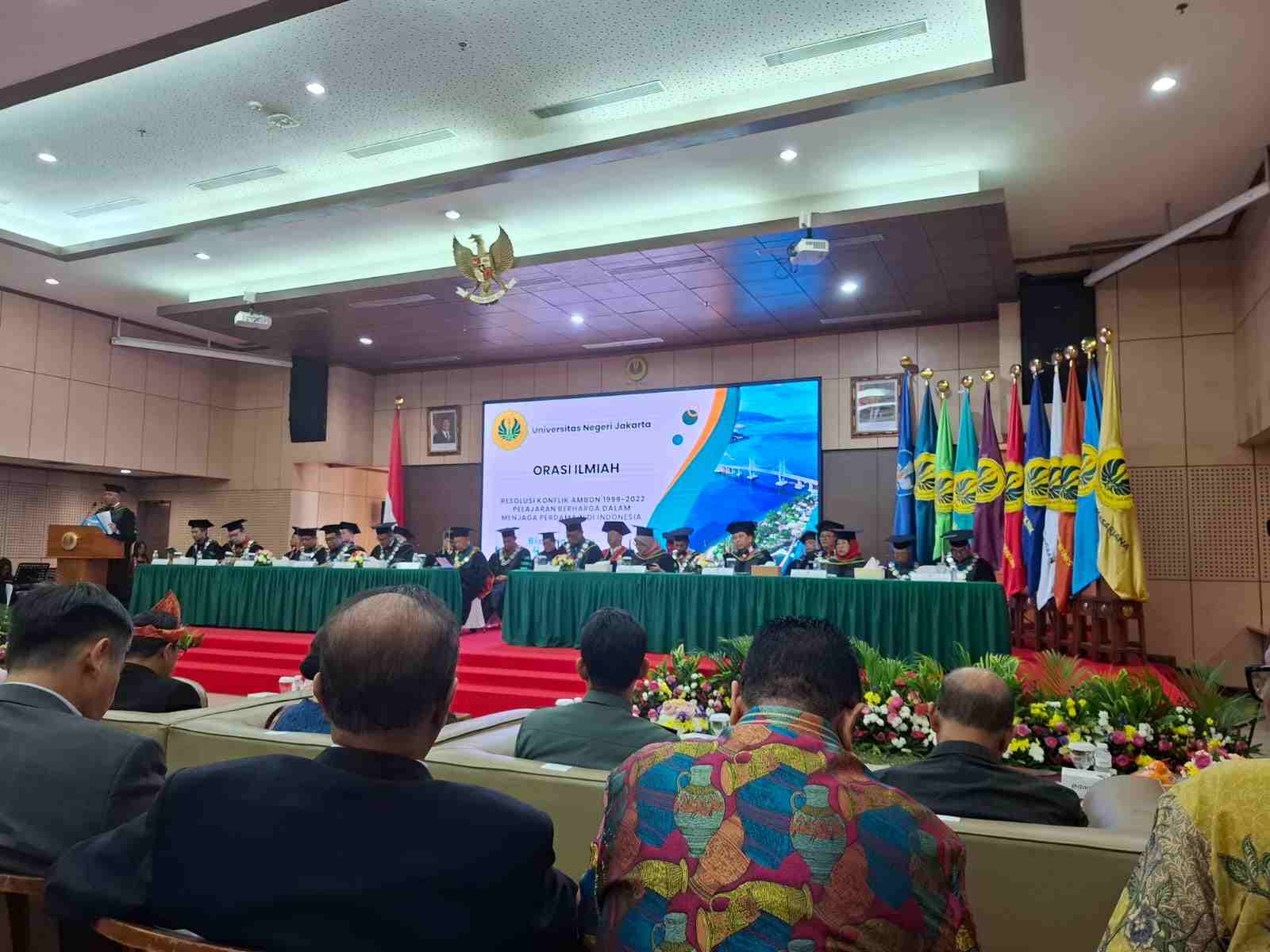
JAKARTA-JAYA NEWS.COM – This article is the second of three articles on the inauguration of Professors at Jakarta State University, Thursday, June 12, 2025. In the second article, it presents a scientific oration delivered by Prof. Dr. Abdul Haris Fatgehipon, S.Pd. M.Si who brought the theme of the Ambon Conflict Resolution 1999-2022 as a Valuable Lesson in Maintaining Peace in Indonesia.
1. Ambon Conflict: Not a Spontaneous Explosion, but a Layered Engineering
The Open Session of the Jakarta State University Senate witnessed history when Prof. Dr. Abdul Haris Fatgehipon, S.Pd. M.Si was inaugurated as a professor. In his scientific oration, Prof. Abdul Haris highlighted how the conflict was not just a sectarian tragedy, but part of a complex geopolitical and social dynamic, which actually gave birth to important lessons for the study of conflict resolution in Indonesia.
Conflict resolution studies, said Prof. Abdul Haris, have become a separate academic field after the Cold War. Its development in the world began in the 1950s and 1960s, when nuclear threats and conflicts between superpowers shook global stability. In Indonesia itself, serious attention to this field emerged after the 1998 Reformation, when vertical and horizontal conflicts spread from Aceh to Papua.
“Indonesia as a multi-ethnic, religious, and cultural country is a living laboratory for the study of peace and conflict,” he explained. It is no wonder that Gadjah Mada University established a Masters Program in Peace and Conflict Resolution in 2021—the first in Southeast Asia—followed by the Defense University with a similar program.
The New Order era, which was known for its repressive nature, was able to maintain stability through a strong security approach, one of which was through the Repelita program. However, the transition to reform opened up space for conflict escalation, including the 1999 Ambon tragedy which many predicted would be a domino effect: after East Timor was released, it was followed by Ambon, Aceh, Papua, until finally Indonesia disbanded.
Ambon, a multicultural city with strong kinship roots, was suddenly dragged into a bloody conflict. This raises a big question: what actually triggered this conflict? For Prof. Abdul Haris, the answer lies in structural, cultural factors, and deep-rooted political actions.
2. Dissecting Conflict Resolution Strategies: From Malino II to Diaspora Diplomacy
This oration is not only the result of conceptual thinking, but also the fruit of long and collaborative research since 2012 between Pattimura University and the National Resilience Council. The research team interviewed kings of the country, religious figures, academics, and even main actors such as the Commander of Laskar Jihad, Zafar Umar Talib, who had experience fighting in Afghanistan against Russia.
The research does not only focus on the domestic side. In 2016, with the support of Deputy Chairman of the DPD RI Dr. Nono Sampono and the Indonesian Ambassador to the Netherlands, Igusti Agung Wesaka Puja, the team interviewed the ex-Kenil Maluku diaspora in The Hague, Netherlands. Many of the second and third generations of this diaspora are now part of the Indonesian National Team. Although often stigmatized as supporters of the Republic of South Maluku (RMS), interviews proved that they actually sympathized with the humanitarian tragedy in Ambon and hoped that the government would be fairer in developing Maluku.
The resolution of the Ambon conflict itself was carried out holistically: involving a security approach, dialogue, law, and rehabilitation. One of its strong pillars was the role of intelligence. However, many parties considered that on January 19, 1999, the TNI and Polri failed to carry out early detection.
This view was refuted by a national intelligence figure, Lieutenant General (ret.) Abdullah Hendropriyono. In his book Philosophy of Intelligence, Hendropriyono emphasized that the New Order intelligence system had different characteristics from the reform era. During the Soeharto era, decisions could be taken quickly and centrally. In fact, in the case of “Petrus”, President Soeharto openly admitted responsibility. Compare this with the reform era, where intelligence users often ‘washed their hands’, as in the cases of Munir and Policarpus.
Another interesting fact: during the conflict, the government actually opened TNI and Polri camps to accommodate more than 30 thousand refugees, but this contribution often escaped the attention of human rights NGOs in Indonesia.–
*To be continued Part 2
—