Cooperatives as a People’s Economic Resistance Movement
Author,Jacob Ereste
Freelance Journalist
The basic principle of cooperatives is that they consist of voluntary and open members. They are managed democratically so that every member has a voice that must be heard and considered. They are not dependent on capital. However, they remain steadfast in the principle of economic participation by and for the members. Every member actively participates in the cooperative’s economic activities.
Equally important, cooperatives—regardless of their form and field of activity—are autonomous and independent and should not be controlled by external parties. Therefore, the duties and functions of cooperative management are not limited to economic endeavors, but also include education, training, and establishing information centers necessary for the advancement of the cooperative and its members, ensuring they are qualified and knowledgeable enough to enjoy the prosperity achieved together with other cooperative members.
Therefore, collaborative networks and ties with other cooperatives are essential for mutual support—not only in supplying goods and necessities needed by cooperative members, but also in accelerating the pace of development and progress of cooperatives that are capable of serving the needs and interests of their members as a whole. They should not exist—and cannot exist—solely for their own enjoyment, as is the practice of the capitalist system. Therefore, the monopoly model—to control a product, system, or access—must be disrupted by the cooperative movement, which must always and consistently proceed from the spirit of mutual cooperation. A sense of togetherness that is distinctly individualistic. Therefore, the role of cooperatives in building a social order that is independent, harmonious, peaceful, prosperous, and just within a harmonious way of life must and must be the core tenet of cooperative awareness in any field.
The idea for the first cooperative in Indonesia was initiated by Raden Aria Wiraatmadja in 1896—long ago in Purwokerto, Central Java. Although not widely known, this people’s financial institution, similar to a cooperative, initially helped local workers avoid loan sharks. Clearly, from the very beginning, the origins of cooperatives in Indonesia were to fight and confront the cruelty of loan sharks who exploited the people’s hard work.
In subsequent developments, the people’s economic resistance movement was further developed by Dr. Mohammad Hatta, now known as the Indonesian Cooperative Movement. The idea explains that cooperatives are an economic system that aligns with the spirit of mutual cooperation as enshrined in the fifth principle of Pancasila, namely social justice for all Indonesian people. It seems that this desire is what the Red and White Cooperative, which is actively working to establish itself in all villages and hamlets across Indonesia, is under the direct command of the Red and White Cabinet, which is directly led by President Prabowo Subianto.
History records that the first cooperative established in Indonesia—long before independence—was the Islamic Trade Union Cooperative, founded by Samanhudi in 1913 in Solo. However, the cooperatives legally registered under Dutch colonial law were those established by the Dutch East Indies government under the “Regeling Inlandche Cooperatirve” (Inlandche Cooperatirve Regulation), as stipulated in Staatsblad 1908 No. 431. Thus, in 1927, cooperatives began to grow in a more organized manner after Bung Hatta popularized the idea of modern cooperatives as part of the people’s economic struggle (and camaraderie).
At least, that was the role of the famous Islamic Trade Union (SDI), whose main driving forces were Samanhudi and Haji Oemar Said Tjokroaminoto. Therefore, from the beginning, the Islamic Trade Union Cooperative’s movement and activities clearly aimed to accommodate the indigenous economic struggle (resistance) against the domination of foreign traders. Therefore, SDI encouraged its members to unite in economic activities, trade together, and purchase goods collectively, as a principle in line with the cooperative concept.
Today, various types of cooperatives exist, including consumer cooperatives, producer cooperatives, savings and loan cooperatives (KSP), service cooperatives, marketing cooperatives, multi-purpose cooperatives (KSU), and other cooperatives, including cooperatives. Transportation.
The main problem with cooperatives in Indonesia is their perceived difficulty in progressing and developing due to weak management and a lack of member support due to weak publications, communication, and information that cooperative managers can utilize regarding education and training efforts to contribute to the development of their members.
The classic problem in cooperative governance, which hinders progress and development, is always complained about due to limited business capital. However, what often occurs in practice is the persistent political and bureaucratic intervention that continues to present obstacles that complicate cooperative business operations. So, instead of being helped, cooperatives tend to be hindered.
Moreover, the motive was merely to obtain a share of the small profits, which was not the primary focus of the cooperative (resistance) movement, which was to help improve the economic welfare of the people.
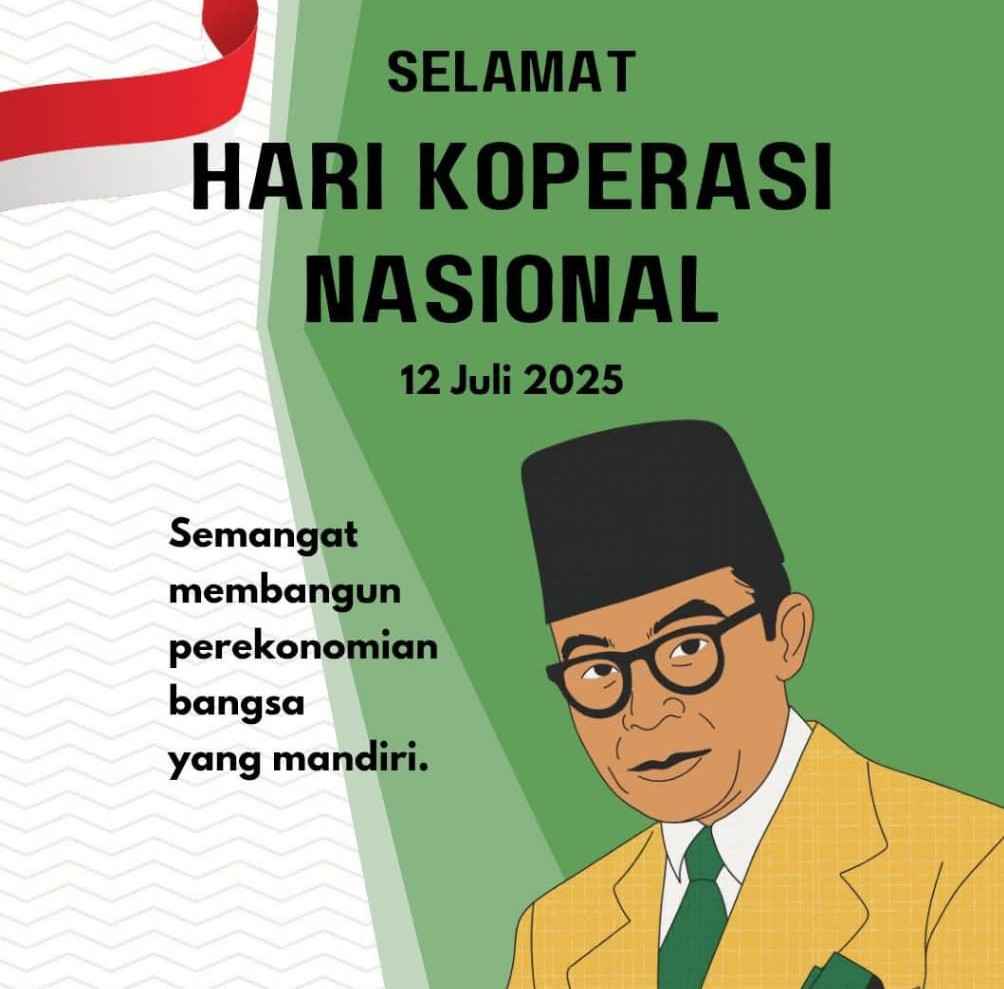
This is how Cooperatives Day began to be commemorated, referring to the Indonesian Cooperative Movement’s congress on July 12, 1947, in Tasikmalaya, 78 years ago. Only two years after the independence of the Indonesian nation and state, which upheld the ideal of freeing the people from poverty and destitution, a goal that remains unrealized to this day. Nevertheless, it is still necessary to say Happy Cooperatives Day, because words are both mantras and prayers. Even though the Indonesian Ministry of Cooperatives appears to be doing nothing, it seems there are too many other matters considered more important than cooperatives themselves.**
Banten, July 12, 2025
—