Dance as a Pillar of Holistic Education at Al-Zaytun
(Series on getting to know the traditions at Al Zaytun)
By Ali Aminulloh
Art as the Foundation of Character Education
At Ma’had Al-Zaytun, art is not a complement to the education system, but rather an integral part of the process of forming a complete human being. In Al-Zaytun’s educational philosophy, the excellence of students is not only measured by the strength of their faith, depth of knowledge, and technical skills, but also by the refinement of their character and flexibility of their soul reflected through artistic expression. The Shaykh emphasized, “Never be rude to art,” as a reminder that art must be approached with noble morals and clear intentions.
One of the art forms that gets the most attention at Al-Zaytun is dance. Since its establishment, Al-Zaytun has established dance as one of the media for developing the character of students. With the vision of forming a generation of Basthah fil ‘Ilmi wal Jism—a generation that excels in knowledge and physicality—dance serves to build harmony between body and soul, between expression and self-control.
Trainers’ Footsteps and Systematization of Dance Learning
The journey of dance art at Al-Zaytun began with the presence of strong trainers such as Inu Kertapati from Cirebon, who introduced students to the Mask Dance, Merak Dance, and Ngremo Dance. Al-Zaytun’s commitment to dance development continues to be strengthened with the entry of professional trainers, including Dra. Puruhitari who joined in February 2017. This experienced figure brings artistic blood from both of her parents—her mother graduated from ASTI Yogyakarta and her father graduated from ASRI Yogyakarta. She also trained at the Bagong Kussudiardjo Dance Training Center (PLT) Surabaya.
Since elementary school, Puruhitari has trained dance at various schools in Surabaya. Her experience continued to be honed until she went to college at UNAIR, as well as through formal training and certification from the East Java Provincial Cultural Park. With an academic background of S1 Anthropology, she brings a cultural and scientific approach to teaching dance at Al-Zaytun.
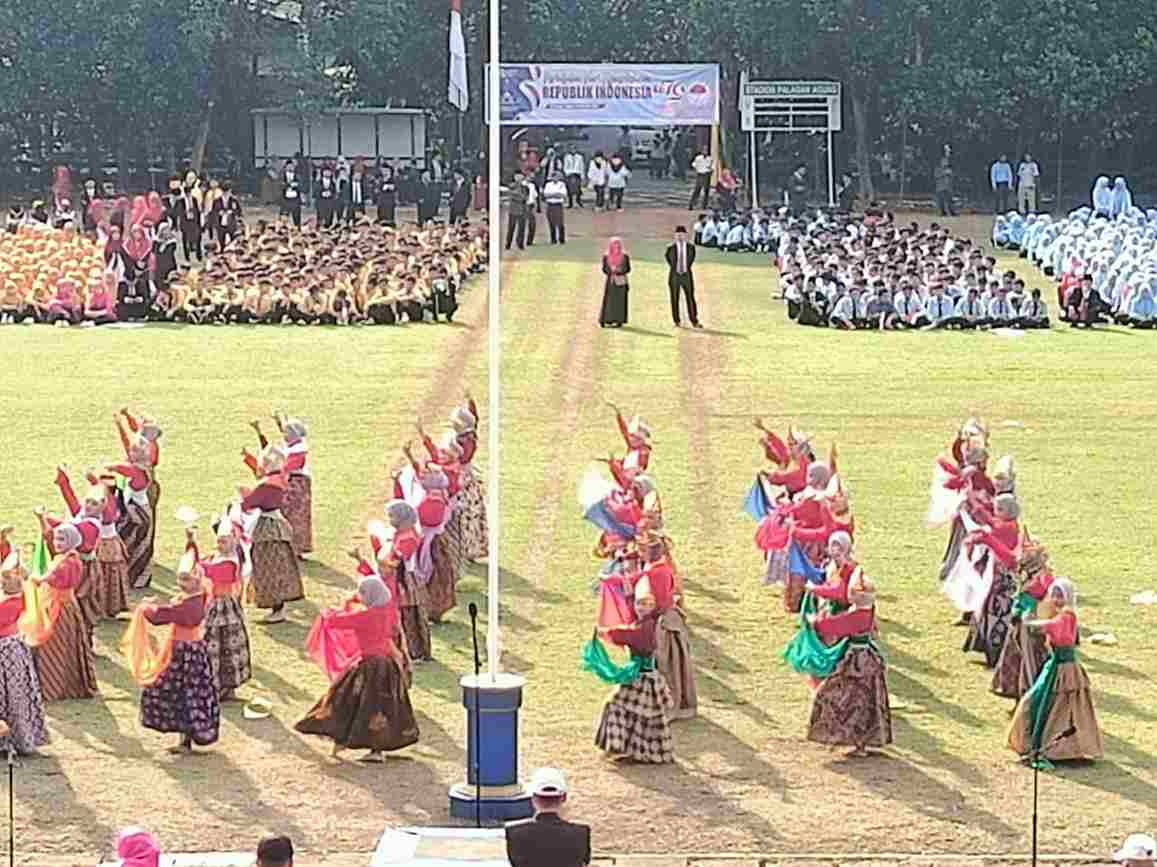
According to Puruhitari, the dance curriculum at Al-Zaytun is designed to be very comprehensive: from traditional, classical, creative, to regional dances from various regions of the archipelago. “To this day, there are 105 types of dances that have been taught to students,” she said. The repertoire includes Acehnese Saman Dance, West Javanese Jaipong Dance, Balinese Dance, to Sajojo Dance from Papua.
Dance coaching at Al Zaytun is carried out from grade 1 MI to grade 12 MA, even extending to PKBM, teachers, and students. The practice schedule takes place every day, at 15.00-17.00, and the evening session at 19.00-21.00 to prepare for the performance. All activities take place in a special practice room on the 2nd floor of the southern dome of Palagan Agung, with professional management under the STAR-Z organization (Seni Tari Al-Zaytun), part of KOSMAZ. For the regeneration of trainers, intensive cadre formation was carried out with Siti Isnaini and Iskarimatun Nisa as assistant trainers.
From Practice to Achievement Stage
The results of the practice do not stop in the dance room. Dance art at Al-Zaytun continues to be actualized in various internal and external events. Routine performances of students enliven the commemoration of 1 Syuro, the annual forum of KSU Deda Kota Indonesia, the August 17 ceremony, Khutbatul Arsy, welcoming new students, IAI Al-AZIS graduation, student festivals, and welcoming guests of honor. In fact, when asked, students are ready to perform at weddings.
The participation of students in competitions outside the campus has also reaped proud achievements. At the end of 2024, five 9th grade students won hope in a Jabodetabek dance competition. A year later, six 10th grade students won 2nd place nationally in the same event. This is proof that the dance arts development system at Al-Zaytun is not only serious, but also effective and produces real results.
But more than that, dance education at Al-Zaytun goes beyond aesthetics and competition. Dance becomes a vehicle for shaping personality. Students learn to appreciate the process, work together, maintain harmony of movement and emotion, foster self-confidence, and build courage to appear in public. All of these are life provisions that cannot be obtained only through cognitive lessons in class.
Epilogue: Dancing on Life Values
Al-Zaytun has elegantly proven that true education is education that touches all aspects of humanity. By including dance as part of the education system, this Ma’had has carved a trail of comprehensive character development—involving the mind, heart, and body. In the hands of dedicated educators and in an environment full of values, dance is no longer just beautiful movement, but becomes a language of the soul that educates, inspires, and shapes a complete person.
Bravo Al-Zaytun! On the stage of life, every movement is a reflection of values, and every step is a trail towards a superior civilization.**
Indramayu, July 4,2025
—