FROM BANGKOK FOR THE FUTURE OF SOUTHEAST ASIA
(59 Years of ASEAN: Upholding Peace, Nurturing Differences, Navigating the Future Together)
By: Ali Aminulloh
Fifty-nine years ago, five people stood in Bangkok carrying the hopes of their respective nations. They came from different nations, languages, cultures, and interests. The world was in the midst of Cold War tensions, Southeast Asia was not yet fully at peace, and newly independent nations were still finding their footing. Yet on August 8, 1967, they chose one important path: to walk together.
From that meeting, the Association of Southeast Asian Nations, ASEAN, was born.
Today, August 8 is no longer just the founding date of a regional organization. It has become a reminder that peace in Southeast Asia is built through the courage to dialogue, the willingness to cooperate, and the ability to remain seated together despite our differences.
In 2026, ASEAN enters its 59th year. From five founding members, the ASEAN family has grown to eleven countries. It is a long journey that proves an idea born out of regional anxiety can grow into one of the world’s important forces.
When Southeast Asia Chose Peace
The 1960s were not an easy time for Southeast Asia.
Many countries had just emerged from colonization. Economic development was fragile. Relations between states were not yet stable. The rivalry of great powers divided the world into political blocs.
Southeast Asia was right in the middle of it.
Amid these conditions came the realization that countries in this region could not forever remain objects of global power struggles. They had to determine their own direction.
Indonesia was represented by Adam Malik. Malaysia by Tun Abdul Razak. The Philippines by Narciso R. Ramos, Singapore by S. Rajaratnam, and Thailand by Thanat Khoman.
These five figures are remembered as the founders of ASEAN.
They signed the Bangkok Declaration on August 8, 1967. The document was not long. But its meaning went far beyond the number of pages.
There was a desire to build peace.
There was hope to accelerate economic growth.
There was determination to advance social and cultural progress.
And most importantly, there was the awareness that the future of Southeast Asia could not be built by turning our backs on one another.
For Indonesia, this event holds special meaning. Indonesia is not just a member of ASEAN. This nation is one of the countries that laid the foundation of the great house of Southeast Asia.
Adam Malik’s name is written there.
August 8: More Than Ceremony
Since ASEAN’s founding, August 8 has become a moment to commemorate the organization’s journey.
Its status was further strengthened when the ASEAN Charter officially designated August 8 as ASEAN Day.
Therefore, ASEAN Day is not a commemoration established by the UN. Nor is it the will of one country.
It is a joint agreement among ASEAN member states.
But a commemoration loses its meaning if it stops at ceremonies, flag hoisting, or official speeches.
ASEAN Day should be a moment to ask again: why must this region continue to cooperate?
The answer is clearer than ever today.
Natural disasters know no borders. Climate change does not stop at immigration checkpoints. Forest fire haze crosses territories. Food crises can affect many countries at once. Pandemics, cybercrime, human trafficking, migrant worker issues, and the digital economy transformation all require collective action.
No single country is strong enough to face all of these challenges alone.
That is why ASEAN remains relevant.
ASEAN Must Be Present Among the People
For too long ASEAN has seemed distant.
People imagine ASEAN as meetings of heads of state, foreign ministers, diplomats, or international conferences with rows of flags and long tables.
But ASEAN should be much closer than that.
ASEAN is about students studying in neighboring countries.
About workers needing protection when working across borders.
About farmers needing markets.
About businesses building trade networks.
About young people collaborating in technology and creativity.
About communities getting to know each other’s cultures.
That is why ASEAN Day is marked with seminars, youth dialogues, cultural festivals, exhibitions, art performances, sports events, student competitions, student exchanges, culinary festivals, and digital campaigns.
All have one important goal: to make people feel that ASEAN does not only belong to governments.
ASEAN belongs to the people of Southeast Asia.
Here education plays a huge role.
Young generations must know Southeast Asia not just as a collection of countries in a geography book.
They must understand that their future will be increasingly connected with communities in Kuala Lumpur, Bangkok, Manila, Singapore, Hanoi, Bandar Seri Begawan, Phnom Penh, Vientiane, Naypyidaw, Dili, and other cities in the region.
2026: Navigating Our Future Together
The year 2026 carries a meaningful message.
Under the Philippines’ chairmanship, ASEAN carries the spirit of “Navigating Our Future, Together.”
Navigating our future, together.
It is like an invitation for all of Southeast Asia to board one big ship.
The sea ahead is not always calm.
Geopolitical waves are rising. Artificial intelligence is advancing rapidly. Climate change is increasingly felt. Issues of food, water, and energy are becoming more strategic. The digital economy is changing the way people live.
In such times, ASEAN must set the course.
Not merely react to changes in the world, but help shape the region’s future.
The most important word in that theme is “together.”
Because the future of Southeast Asia cannot be determined by the largest country alone.
Nor by the richest country alone.
The region’s future must be built through the solidarity of all countries and all their peoples.
From Five to Eleven
Imagine Bangkok in 1967 again.
Back then there were only five countries.
Today ASEAN has grown to eleven.
That journey has not always been smooth. There are differences in political interests. Economic challenges. Issues of democracy, human rights, migration, environment, regional conflicts, and development gaps.
But that is precisely where the meaning of community is tested.
Unity does not mean everyone must think the same.
Unity is the ability to keep talking despite differences.
Peace is not just the absence of war.
Peace is the ability to manage differences without destroying one another.
Southeast Asia is one of the most diverse regions in the world. Hundreds of millions of people live here with different languages, religions, customs, political systems, and histories.
But diversity does not have to be a weakness.
If managed wisely, it becomes a strength.
Indonesia and Its Historical Responsibility
Indonesia holds an important position in ASEAN’s journey.
Indonesia is the most populous country in the region. The ASEAN Secretariat is in Jakarta. And more fundamentally, Indonesia is one of the founding countries.
That means Indonesia has a historical responsibility to keep ASEAN a peaceful, just, and prosperous region.
That spirit can start with simple things.
Respecting differences.
Caring for the environment.
Building open education.
Fostering a fair economy.
Using technology to bring people together, not divide them.
Because regional peace is actually built from people’s daily behavior.
We cannot talk about ASEAN peace if our societies are still quick to hate those who are different.
We cannot talk about the region’s future if its environment continues to be destroyed.
We cannot talk about prosperity if progress is enjoyed only by a small part of society.
Eleven Flags, One Future
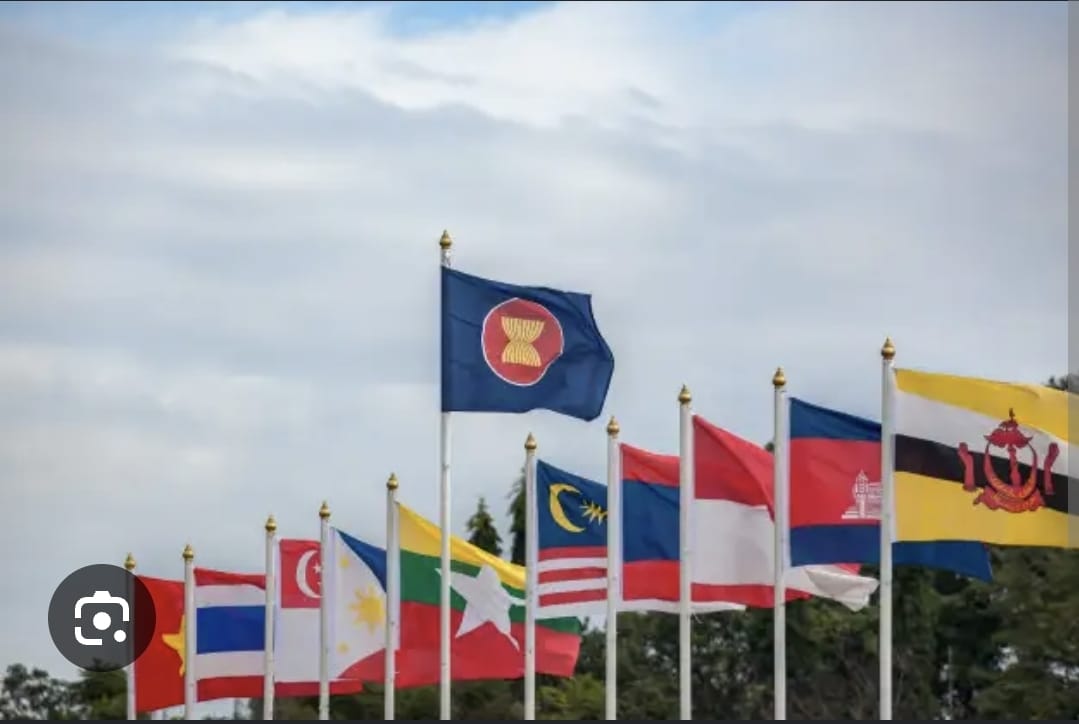
On August 8, 2026, ASEAN flags will fly again.
“The ASEAN Way” song will be played again.
Speeches will be delivered again.
But there is a message far more important than all the ceremonies.
Eleven countries may have different flags.
Their people may speak different languages.
They may have different religions, cultures, and political systems.
But they live in the same region.
The sea connects them.
The air unites them.
Environmental threats come to them together.
And the future will bring them even closer.
Fifty-nine years ago, five countries chose to begin a journey together.
Now our generation bears a different responsibility: to ensure that journey does not lose its direction.
Navigating the future together.
Not because we always agree.
Not because we are always the same.
But because history has taught us that cooperation is stronger than suspicion, dialogue is nobler than hostility, and peace is always the best ground for civilization to grow.
Happy ASEAN Day, August 8, 2026.
May Southeast Asia continue to be a home for diversity, a region for peace, and a shared space to build a more humane future.**
Indonesia, August 8, 2026
——-