From Indramayu for Indonesia:
Towards a Revolutionary Transformation of Boarding School Education for a Modern Indonesia in the 21st Century and 100 Years of Independence
By: Ali Aminulloh
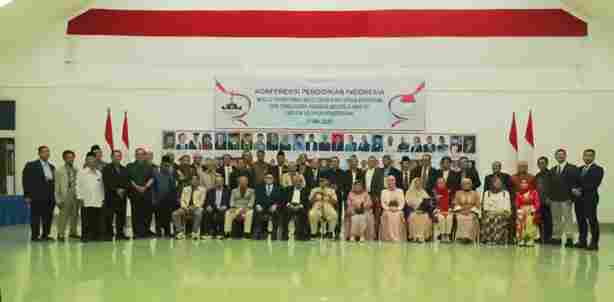
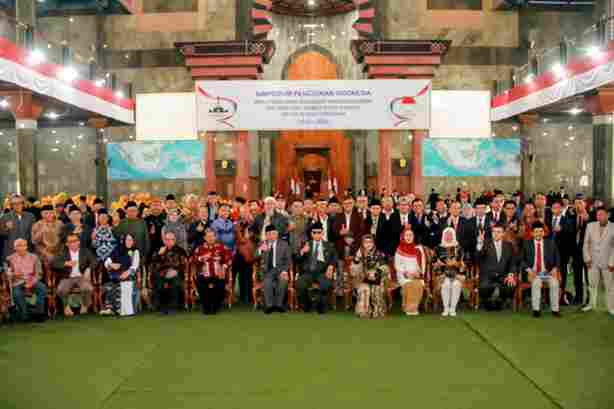
Indramayu, June 1, 2026. That morning, the Rahmatan Lil Alamin Al-Zaytun Mosque was not just a meeting room. It transformed into a space for reflection and hope. On Pancasila Day, dozens of professors, professors, intellectuals, education practitioners, community leaders, and education administrators gathered in a forum with the overarching theme:
“Towards a Revolutionary Transformation of Boarding School Education for a Modern Indonesia in the 21st Century and 100 Years of Independence.”
The Indonesian Education Conference, held from May 31 to June 1, 2026, was a follow-up to the 45-week educational training program conducted at the Ma’had Al-Zaytun. More than 3,000 participants from various elements of the education ecosystem attended the training for sustainable educators, including teachers, lecturers, foundation administrators, students, farmers, education advocates, and parents.
Amidst the various challenges in national education, this forum sought to answer one major question:
How can Indonesia develop superior human resources to welcome its centenary of independence?
Education as a Path to Civilization
Amidst the various views that emerged, one conclusion was clear: education is not merely a process of transferring knowledge, but the foundation for building a nation’s civilization.
The professors in attendance saw that Indonesia needed a more fundamental educational transformation. It was not enough to simply improve the curriculum, add classrooms, or update learning technology. What was needed was a paradigm shift in how Indonesians were formed.
In this context, boarding school education was seen as having a distinct advantage.
Education does not take place solely in the classroom, but rather 24 hours a day, in everyday life. The values of discipline, responsibility, togetherness, leadership, spirituality, and independence can be instilled more comprehensively because students live within an integrated learning ecosystem.
Al-Zaytun as an Integrated Educational Laboratory
Many speakers cited Ma’had Al-Zaytun as a concrete example of boarding school education that has been operating for decades.
In this vast area, education goes beyond theory. Students and students learn directly about agriculture, animal husbandry, food security, economics, cooperatives, technology, and even social life.
They learn not only about agriculture, but also how to farm.
They learn not only about economics, but also about carrying out economic activities.
They learn not only about togetherness, but also about living together in diversity.
This model is what many conference participants referred to as experiential learning, an approach considered increasingly relevant to face the challenges of the 21st century.
The Big Idea: 500 National Boarding Schools
The conference’s discussions culminated in a grand idea: the development of 500 Integrated National Boarding Schools throughout Indonesia.
This idea is projected to be the pivot of Indonesia’s human resource development towards Indonesia Emas 2045 and even towards the centenary of the Republic of Indonesia’s independence.
The proposed concept extends beyond a school or campus. The educational center is designed as a complete ecosystem integrating education, food security, technology, a productive economy, research, character development, and national leadership development.
Through the LSTEAMS (Law, Science, Technology, Engineering, Arts, Mathematics, and Spirituality) approach, education is expected to produce a generation that is intellectually intelligent, morally strong, creative in its work, and ready to face global change.
Between Optimism and Realism
Despite widespread support, the professors also offered several critical comments.
Questions regarding funding, land requirements, human resource readiness, program sustainability, and the potential for social conflict were crucial to the discussion.
Several academics cautioned that grand ideas must be supported by strong academic studies, mature economic analysis, and realistic implementation strategies.
Pilot projects are considered a more feasible initial step before the program is expanded to other regions.
However, the majority of conference participants agreed that these challenges are not a reason to abandon grand ideals.
Instead, challenges should serve as the basis for refining the concept so that it can be realized gradually and sustainably.
Building Human Resources for Indonesia 2045
Amidst the rapid development of artificial intelligence, digitalization, and global change, the conference this session emphasized that the most important factor remains human resources.
Technology may develop rapidly, but a great nation still needs individuals with character, integrity, knowledge, and resilience in the face of change.
Therefore, future education is required to produce not only intelligent graduates, but also individuals capable of leading, innovating, collaborating, and upholding national values.
Indonesia needs scientists, technopreneurs, researchers, leaders, and innovators born from a strong education system.
From an Ideal to a National Movement
In the closing session, a message was conveyed that was repeated throughout the conference:
The Indonesian nation must not wait for other nations to build its future.
Indonesia’s awakening must arise from the awareness of the Indonesian people themselves.
Education is the primary path to this ideal.
What took place on the 5th floor of the Ali Building and the Rahmatan Lil Alamin Al-Zaytun Mosque in early June 2026 may have been just a conference. But for the participants, the forum was more than just an academic gathering.
It was a space where great ideas were born.
A collective effort to envision Indonesia, one hundred years after its independence, as a nation advanced, characterized, independent, knowledgeable, and dignified in the global community.
And like every great ideal in a nation’s history, it always begins with the courage to first imagine it.**
Indonesia, June 2, 2026
——