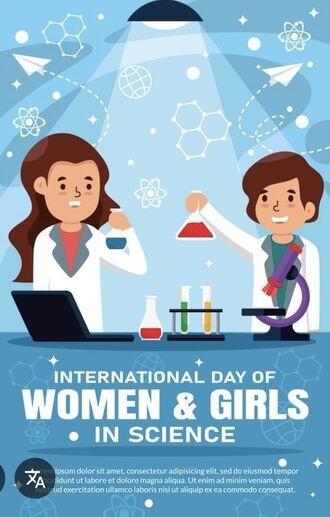
When Science Never Questions Gender, Why Does the World Still Do It?
(Reflection on the Day of Women and Girls in Science, February 11)
By: Ali Aminulloh
Science is neutral, but civilization often isn’t.
Science is born from curiosity, not from gender. It grows from the courage to think, not from social labels. Yet, an irony arises in the human world: neutral science is often trapped within unequal structures. It is from this paradox that February 11 is celebrated as the International Day of Women and Girls in Science: a global reminder that knowledge equity still needs to be fought for.
February 11 is not just a calendar marker. It is a symbol of global awareness, officially established by the United Nations through resolution A/RES/70/212 on December 22, 2015. The world recognizes one crucial fact: the future of science and technology will not be intact if women and girls continue to be marginalized.
Science Advances, Representation Lags
Women have long been present in the history of science, researching, teaching, creating, and inspiring. However, data and social realities show a gap that has not been fully closed. In the STEM (Science, Technology, Engineering, and Mathematics) fields, women remain underrepresented, both in terms of access to education, research opportunities, and policy-making positions.
This issue is not simply a matter of ability, but rather a systemic one. Therefore, the International Day of Women and Girls in Science is presented with a clear goal: to raise awareness, expand participation, and reduce the gender gap in the world of knowledge.
Novum Gradum: Taking a New Step in Education
Amidst these global challenges, the concept of novum gradum (a new step) initiated by Shaykh Al-Zaytun finds relevance. Education must not simply repeat old patterns; it must boldly leap forward, respond to the times, and unleash the potential of all human beings.
Through the LSTEAMS (Law, Science, Technology, Engineering, Art, Mathematics, and Spirituality) approach, education is directed towards producing complete human beings. For women and girls, LSTEAMS is not just an integration of disciplines, but a safe space for growth: critical thinking without losing one’s conscience, innovation without being deprived of values, and excellence without abandoning humanity.
The Trilogy of Consciousness: The Foundation of Humanizing Science
February 11th is truly a celebration of consciousness. This is where the trilogy of consciousness finds its momentum.
Philosophical consciousness guides women and girls to recognize their true nature as subjects of knowledge, not mere objects of policy.
Ecological consciousness positions science as a tool for preserving life, not disrupting the balance of the earth.
Social consciousness ensures that science stands for justice, equality, and human dignity.
Without these three awarenesses, science risks becoming cold and elitist. With them, science becomes a path of service.
IDEA 2026: From Presence to Leadership
The 2026 theme, “Innovate. Demonstrate. Elevate. Advance. (IDEA),” affirms the direction of the struggle. Women and girls are no longer simply “involved.” They are encouraged to lead innovation, demonstrate their capacity, elevate the quality of civilization, and advance the world with a more just and balanced perspective.
This commemoration is celebrated through seminars, workshops, awareness campaigns, and awards, but its essence is much deeper: building an equitable knowledge ecosystem.
The Future Is Not Neutral If Opportunities Are Unequal
If science is the language of the future, then women and girls are its irreplaceable speakers. Celebrating February 11th means nurturing the hope that science will one day be not only intelligent but also wise; not only advanced but also humane.
Because ultimately, the big question is no longer whether women are capable in science, but rather: can the world progress without them?
Indonesia, February 11, 2026
——–