Green Prayer Rugs on Wounded Land: When Religion Is No Longer Busy Digging Mines
(Reflection on International Environmental Education Day)
By: Dr. Ali Aminulloh, M.Pd.I., M.E.
The Earth has never needed humans to keep it turning, but humans will lose everything without a piece of land to stand on. This is the greatest paradox of this century: we are building civilization on the foundations we ourselves are destroying. As Sumatra is engulfed in grief by the wrath of nature and other parts of the world are devastated by extreme weather, we are just realizing that nature is a silent “master,” and we are merely noisy “passengers.”
Unfortunately, that awareness is often as thin as tissue paper. It easily shatters when it clashes with business lust and political calculations. Even more ironic, we have recently witnessed an anomaly: community organizations, which should be moral and spiritual guardians, are instead starting to queue at mining concession counters. Where is God’s voice when heavy equipment begins to tear apart the lungs of the earth?
Ecotheology: Beyond the Minarets
Amidst this chaotic conflict of interests, the Ministry of Religious Affairs has begun to promote an important discourse: Ecotheology. This idea is not merely rhetorical sweetener. Ecotheology demands that religion not remain confined to the cold tiles of mosques or the walls of madrasas.
Religion must descend to the earth, unite with the roots of trees, and flow with the waters of rivers. If God is the creator of the universe, then destroying nature is the most obvious form of blasphemy. This is the point where faith must transform into ecological action.
Al-Zaytun and the Philosophy of “Big John”
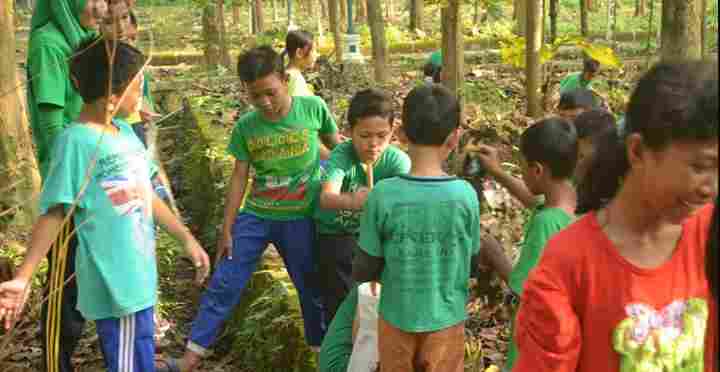
Long before environmental issues became a global trend, Ma’had Al-Zaytun, under the leadership of Sheikh AS Panji Gumilang, practiced contemporary education that was ahead of its time. Here, education was not merely about memorizing texts, but rather fostering a comprehensive philosophical, ecological, and social awareness.
One concrete demonstration of this heightened awareness is how infrastructure development was carried out without “killing” life. Al-Zaytun has an elegant approach: instead of cutting down trees blocking the development path, they use Big John trucks to move the large trees to new locations.
The message is clear: Development doesn’t have to mean destruction. At Al-Zaytun, harmony isn’t just a slogan, but a practiced balance. It’s a model for how humans should position themselves before nature as caretakers, not tyrannical rulers.
Global Mandate and Our Future
This momentum becomes even more relevant when we look back at history. In 2002, UNESCO established the International Day of Education for Sustainable Development. Its goal is one: to change human behavior to be kinder to our big home, the Earth.
Environmental education isn’t just about planting a tree one day a year and then forgetting about it. It’s about:
– Ongoing awareness campaigns.
– Curriculum transformation that integrates sustainability.
– Concrete community action that keeps ecosystems breathing.
If the world is to survive, we must return to square one: realizing that we are part of nature, not its owners. Syaykh AS Panji Gumilang through Al-Zaytun has provided the blueprint. Now the choice is in our hands: stay busy digging mine holes in the name of momentary prosperity, or start spreading “green prayer mats” for the sustainability of future generations.
Because, in the end, nature will still exist even without us. However, without nature, our prayers might no longer have a place to be said.**
Indonesia, January 26 2026
——