By: Adlan Daie
Political Analyst, General Secretary of the Indonesian Ulema Council (MUI) for Indramayu Regency
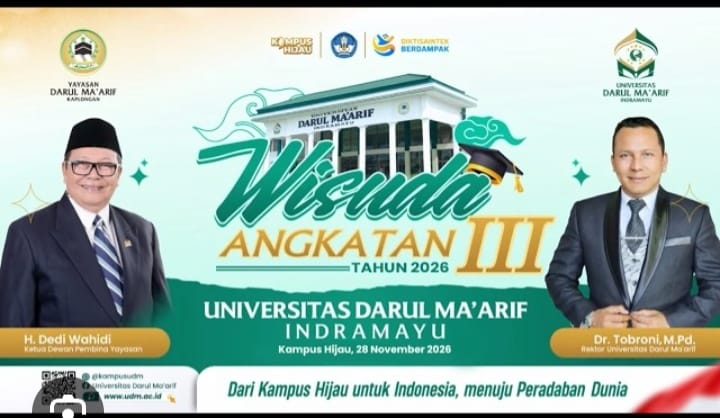
What is particularly noteworthy—at least from the perspective of this writer, who attended the third commencement ceremony for students of Universitas Darul Ma’arif (UDM) Kaplongan, Indramayu, on Saturday (November 22, 2026)—is not merely the well-organized and seamless ceremonial procession characteristic of the “Green Campus” of Kaplongan.
The compelling aspect lies in the symbolic messages conveyed: the spirited address by UDM Rector Dr. Tobroni—which brought to mind the powerful, rhythmic verses of the poet Chairil Anwar—and the guidance offered by H. Dedi Wahidi, Chairman of the Board of Trustees of the Darul Ma’arif Kaplongan Foundation (who also serves as a member of the Indonesian House of Representatives). His tone was paternal, yet punctuated by a recurring, informal “millennial-style” greeting to the students: “Hello!”
The podium from which both men spoke served as a “bully pulpit”—a term coined by Theodore Roosevelt, the 26th U.S. President—acting as a platform to instill “inner power” in the students, empowering them to secure their own futures. This was further enriched by the remarks from Dr. Caridin, Head of the Indramayu Regency Education Office, and a representative from LLDIKTI Region IV.
In his impassioned address, UDM Rector Dr. Tobroni emphasized that “this graduation is not the end of the learning process,” while H. Dedi Wahidi urged the graduates to remain open-minded and “not be overly selective” when it comes to job opportunities after graduation. This also reminds the author of an old book containing the “ideological letters” of J. Rockefeller, a prominent billionaire from the early 20th century.
As his son neared the end of his university studies, J. Rockefeller wrote to him:
“You must believe that you yourself are your greatest asset—not your father’s wealth. You will stand firm on your own two feet,” Rockefeller wrote to his son.
“In this world, nothing can surpass perseverance. Education alone is not enough. Only perseverance will never let you down when it comes to your future. That is character,” he continued.
In a historical sense, H. Dedi Wahidi has emerged and grown through the consistent application of this very perseverance. He succeeded in “transforming” the rice fields and swamps of Kaplongan into an educational complex—a testament to his persistence and his unwavering spirit to secure the future by relying on his own strength.
This is character in action—the ability to discern between fundamental principles and the strategic or tactical choices required to orchestrate the various components of the Darul Ma’arif Kaplongan educational ecosystem. It is not merely a collection of well-structured physical buildings; it is an institution defined by measurable management—from inputs and outputs to outcomes, to borrow terms from bureaucratic technocracy.
He embodies the philosophy of *ing ngarso sung tulodo* (setting an example from the front), *ing madyo mangun karso* (igniting spirit from within the group), and *tut wuri handayani* (providing motivation from behind). Sadly, many Islamic educational institutions today face public scorn—shifting from being sources of guidance to becoming mere “spectacles”—as they seem to follow a distorted path: *ing ngarso golek bondo* (seeking personal wealth while at the helm) and *tut wuri cawe-cawe* (meddling in affairs from the rear). The core of this brief note touches upon what Benedict Anderson once wrote regarding “imagined communities”—the idea that the vision of a future society can be shaped through social engineering, driven by the process of education. As Prof. Soedjatmiko noted, education is both a “commendable” and a “battle-tested” instrument for steering society toward a future civilization.
In other words, it is difficult to imagine what kind of social transformation the community of Kaplongan and its surrounding areas might have undergone had H. Dedi Wahidi—forty-four years ago, in 1983—not dared to embrace the principle of “leadership as suffering” (a term coined by the legendary diplomat H. Agus Salim) by pioneering a path through education.
It is within this context that I interpret the remarks made by the Rector of UDM, Dr. Tobroni, who cited the phrase “Khairun nas anfa’ linnas”—striving to be a person who contributes as much as possible to the well-being of one’s social environment.
Congratulations to UDM and to all the students who have graduated. Awaken the spirit to win the future.
Best regards.
Indramayu, November 29, 2026
—-