FKSTIM Open Discussion
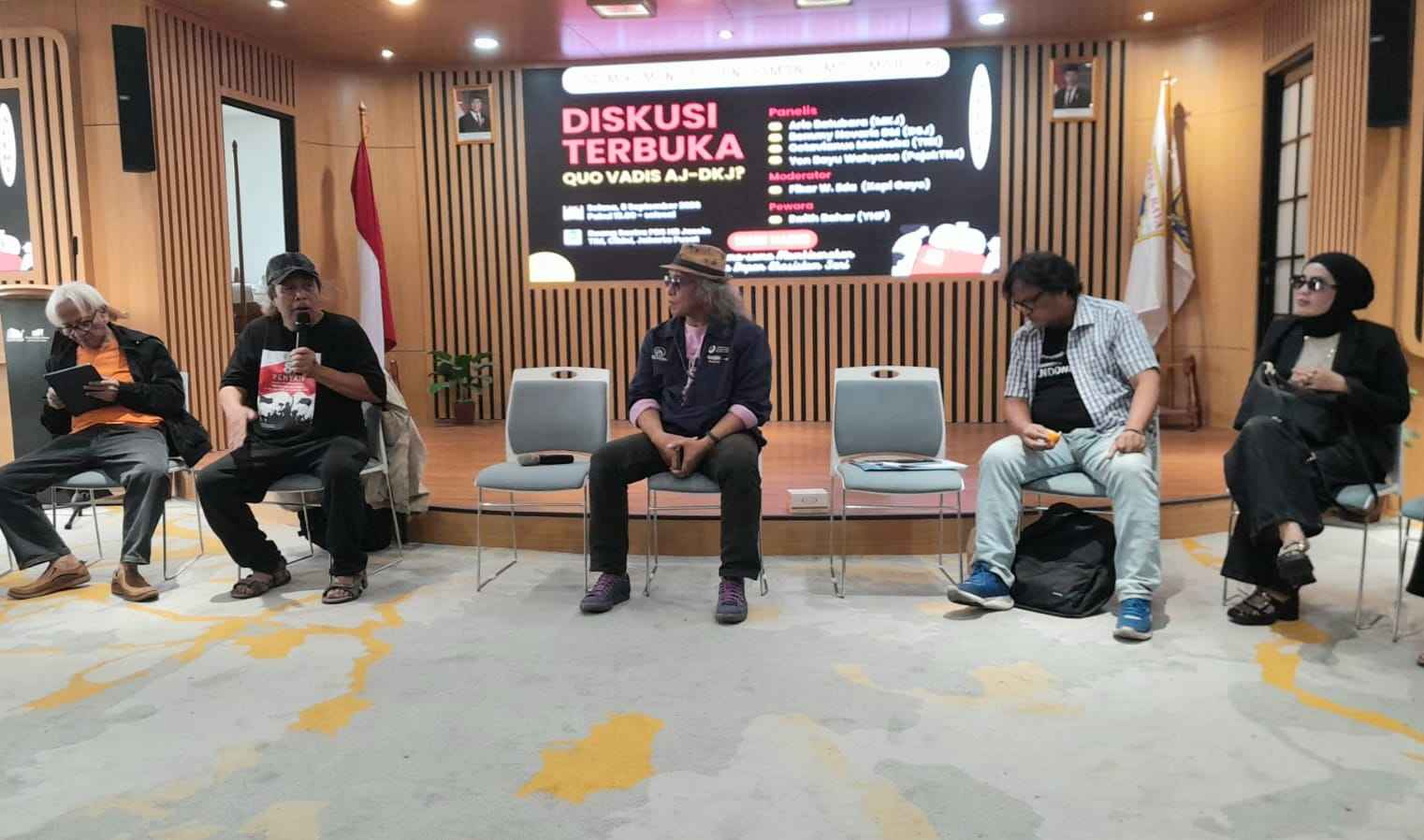
JAKARTA-JAYANEWS.COM – An open discussion organized by the Taman Ismail Marzuki Arts Community Forum (FKSTIM) proved to be a dynamic affair. The appointment of members to the Jakarta Arts Council (DKJ) for the 2026–2027 term took center stage, drawing dozens of leaders and administrators from various arts communities—particularly those in the fields of literature and theater.
Moderated by Ewith Bahar of the Poetry Day Foundation (YHP), the event opened with poetry readings by several poets, including Nunung El Niel, Willy Ana, and Yogi Karman.
Following the readings, Fikar W. Eda moderated the open discussion held at the PDS HB Jassin center in TIM, Cikini, Central Jakarta, on Tuesday (September 8, 2026).
To kick off the discussion, FKSTIM Coordinator Yon Bayu Wahyono outlined the chronology of the objections raised regarding the inauguration of DKJ members by the Governor of the Special Region of Jakarta, Pramono Anung, on August 5, 2026.
After detailing the sequence of events—ranging from the registration process for DKJ candidates to the execution of the Jakarta Arts Deliberation (MKJ)—Yon Bayu highlighted key points where the Jakarta Academy (AJ) allegedly violated regulations. He argued that these actions contravened Governor’s Regulation Number 4 of 2020, which serves as the legal framework governing the entire selection process for AJ and DKJ members.
First, the AJ only finalized the selected candidates for the 2026–2029 DKJ term on July 23, 2026—merely four days before the expiration of the 2023–2026 DKJ members’ term of office, as stipulated in AJ Decree No. …02 of 2026.
“Secondly, an open fit-and-proper test was not conducted for all Selected Candidates resulting from the MKJ process, as required by Article 25, paragraphs (9) and (10). Via Letter No. 15/V-KAJ/2026 dated May 22, 2026, AJ invited only 46 Selected Candidates to participate in the selection interviews for DKJ members for the 2026–2029 term,” stated Yon Bayu.
Violation of Governor’s Regulation No. 4 of 2020
The third and most significant point is that AJ appointed only 25 DKJ members for the 2026–2029 term, distributed as follows: the Literature Committee has 3 members; the Theater, Music, and Dance Committees each have 4 members; and the Film and Visual Arts Committees each have 5 members.
“This appointment decision violates Governor’s Regulation No. 4 of 2020—specifically Article 23, paragraph (1), which mandates that the number of Ordinary Members shall be 30 (thirty), and Article 24, paragraph (2), which states that the number of members per committee shall be 5 (five),” Yon Bayu emphasized.
The culmination of these violations was the inauguration of the DKJ members for the 2026–2029 term by the Governor of the Special Region of Jakarta on August 5, 2026, at City Hall, in accordance with AJ Decree No. 2 of 2026.
Octavianus Maheshka, Chairperson of *Taman Inspirasi Sastra Indonesia* (TISI), explained the relationship between AJ, the DKJ, and the communities at TIM.
Octa—as he is familiarly known—stated that the role of art communities in the growth and development of the arts ecosystem in Jakarta, particularly at TIM, is vital and strategic. “However, the voice of the arts community was completely ignored during the crucial process of selecting DKJ members at the MKJ (Arts Council Deliberation) event. Participants in the MKJ—who, after all, come from the arts community—were denied the right to vote for candidates. Everything was left to the AJ (Arts Council), which violates Governor’s Regulation Number 4 of 2020,” asserted Octa.
A Unified Entity
The third panelist, Remmy Novaris DM—Chair of Dapur Sastra Jakarta (DSJ)—outlined the spirit behind the establishment of TIM as an integrated arts ecosystem, where the DKJ, AJ, UP PKJ TIM, and the Jakarta Institute of the Arts (IKJ) function as a single, unified entity.
“That was the vision of Jakarta Governor Ali Sadikin when founding the Jakarta arts center. Yet now—especially since the arrival of Jakpro (PT Jakarta Propertindo)—it seems as though all these institutions are operating in isolation,” said Remmy.
Speaking last, Arie Batubara detailed several fundamental errors regarding the selection process for AJ and DKJ members, including issues concerning the size and composition of the MKJ.
“The inauguration of new AJ members violated regulations because, reportedly, the matter was not deliberated within the MKJ; the names were simply read out,” said Arie, a former DKJ member.
Abu Hasan, an AJ secretariat staff member present at the discussion, offered a response.
He suggested that the current situation is rooted in history. However, Abu declined to elaborate further and even stated that he was not representing the AJ.
Yogi Karman and Dinal highlighted the importance of engaging in dialogue with the AJ to address these issues. “After all, the AJ might have other considerations or may have exercised its discretion in appointing DKJ members,” said Yogi.
In response, Yon Bayu noted that discretion cannot be exercised recklessly. The legal framework governing this is Law Number 30 of 2014 concerning Government Administration.
There are three grounds upon which public officials may exercise discretion.
First, discretion may only be exercised when the law is silent, unclear, or ambiguous. In fact, Articles 23 and 24 of DKI Governor’s Regulation No. 4/2020 set out the figures in black and white, in rigid terms. There must be 30 ordinary members, and each commit must consist of five people.
Since the figure is absolute and unambiguous, AJ has absolutely no room for alternative interpretations.
“Exercising discretion in the face of clear regulations is not a policy decision; rather, it is a unilateral interpretation that violates the rules,” asserted Yon Bayu.
Secondly, a fundamental requirement for exercising discretion is that it must not contravene applicable laws. In reality, by limiting the Literature Committee to three members and the Theater, Music, and Dance committees to four members each, AJ knowingly violated the organizational structure established by Governor’s Regulation No. 4/2020.
“Remember, in the selection process, AJ acts as the implementer or executive body, not the rule-maker or legislature. If AJ wanted to change the number of committee members, the proper course of action would have been to request that the Governor revise the regulation, rather than arbitrarily cutting quotas under the guise of discretion,” the former journalist explained.
Thirdly, there were no compelling emergency circumstances. The exercise of discretion is intended to address urgent emergencies in the public interest.
In fact, there was a more than adequate pool of candidates—104 individuals, nearly three times the number actually selected. There was no emergency situation or shortage of candidates that would have made it impossible to meet the five-person quota.
Riri Satria (Jagat Sastra Milenia), Ireng Halimun (Sastra Semesta), Imam Ma’arif (Planet Senen), Adhi Ayoe, Aquino Hayunta, and others recommended following up on the issue by establishing a special team.
“If there is truly no other option, the findings of that review could serve as the basis for a lawsuit in the Administrative Court (PTUN),” suggested Ireng Halimun.
During the open discussion, voices also called for the dissolution of AJ if it failed to provide a transparent and accountable explanation.
FKSTIM’s next step is to send a second letter to the Governor of Jakarta requesting an explanation. If the Governor still fails to provide an adequate response, FKSTIM will pursue legal action through the Administrative Court.(***)
Author : Lasman Simanjuntak
Editor : Nuryaji
——–