

A Space That Nurtures the Soul: Al Zaytun and the Revolution of Boarding School Education
By Dr. Ali Aminulloh, M.Pd.I., ME.
Amidst a world of education often trapped solely in numbers, rankings, and graduation rates, Ma’had Al Zaytun has chosen a quieter yet more profound path: educating people through life. Since June 1, 2025, Al Zaytun has consistently held training for students as part of its endeavor to realize a revolutionary transformation of boarding school education. Entering its 29th week, this initiative affirms the crucial belief that true education does not take place solely in the classroom, but is lived in people’s daily lives.
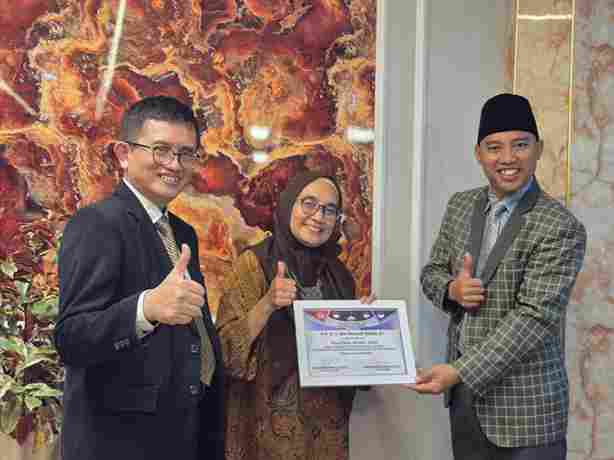
On Sunday, December 21, 2025, the training featured Prof. Dr. Ir. Dhini Dewiyanti Tantarto, MT, Professor of Behavioral Architecture from the Indonesian Computer University. She came not merely with theory, but with a perspective: that space is a silent teacher, working relentlessly to shape human behavior.
Dormitory: Where Knowledge Meets Life
For Al Zaytun, the dormitory is more than just a building with neatly arranged beds. It is a 24-hour living space, where students wake up in the morning, learn to share, experience conflict, reconcile, feel tired, and then get back up again. It is there that values are not taught through memorization, but rather developed through experience.
In Prof. Dhini’s view, boarding school education has a fundamental advantage because it shapes social habits. Students live in a small community that serves as a miniature model of the future society. They learn empathy from sick friends, discipline from routines, and responsibility from shared spaces. Education is no longer instructional, but transformational.
When Space Helps Shape Character
Through a behavioral architecture approach, it is explained that the relationship between humans and space is reciprocal. Space shapes behavior, and behavior, in turn, transforms space. Narrow corridors cultivate order, open courtyards encourage interaction, private zones teach boundaries, while communal spaces foster mutual cooperation.
Even things often taken for granted, such as lighting, ventilation, and wall color, have an impact on a child’s psychological health. A healthy space can soothe the soul, while a stressful one can breed anxiety. At this point, space becomes a hidden curriculum: it doesn’t speak, but teaches; it doesn’t advise, but shapes.
From Control to Humanity
Prof. Dhini also cautioned that many dormitories are still designed with the old paradigm: facilitating supervision, not fostering human development. Rigid and hierarchical spatial patterns often create order but sacrifice warmth.
Instead, dormitories of the future need to move toward humanistic, flexible, and layered spaces. Children need space for togetherness as well as space for solitude; a place for serious study as well as space for expression and reflection. A good dormitory is not the one with the strictest control, but rather the one most sensitive to human needs.
Al Zaytun as a Living Laboratory
This idea resonates in Al Zaytun’s practices. The dormitory’s structured management, proportional age distribution, and 24-hour life support demonstrate that education is understood as a living ecosystem. Children are not left to grow up alone, but are accompanied, without losing the space for independent learning.
The dormitory becomes a social laboratory: a place to learn micro-democracy, leadership, collective responsibility, and adaptation to the challenges of the times, including the digital era. Students are prepared not only to pass exams, but to live in the real world with mature character.
A Silent Revolution That Determines the Future
What Al Zaytun is doing is truly a silent revolution. It is not noisy with jargon, not busy chasing image. It works through space, habits, and role models. Through conscious life design, values are instilled without coercion, character is formed without shouting.
Ultimately, this 29th week of training is not simply a record of activities, but a reflection of the direction of education we are choosing. Al Zaytun demonstrates that education is not only about what is taught, but also where and how people live. Spaces arranged with an awareness of values will give birth to orderly souls; a humane environment will foster civilized human beings. It is there that education finds its deepest meaning: not merely producing graduates, but preparing people to live, lead themselves, and eventually give meaning to the world around them. It is a long, silent endeavor, but one that determines the direction of the nation’s future.***
Indramayu, December 21, 2025
——–


