Graduation as a Humanitarian Mandate: Message from a National Human Rights Commissioner at the Al-Azis Islamic Institute Graduation
By Ali Aminulloh
From Work Ethic to Human Rights
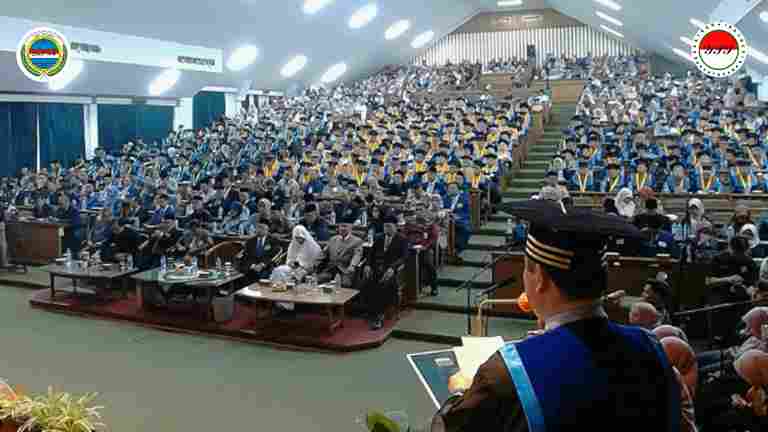
The 6th graduation ceremony of the Al-Zaytun Islamic Institute (IAI Al-AZIS) in Gantar Village, Indramayu Regency, held on Monday, December 15, 2025, was not simply a ceremony to confer academic degrees. More than that, this occasion served as a space for in-depth reflection on the noble task of academics in building the nation. Behind the togas worn and the diplomas received, lies a significant mandate: to utilize knowledge as a path to service for the benefit of the people, society, and nation.
With the theme “Cultivating Work Ethic, Motivation, and Discipline, Producing Productive Human Resources,” this graduation affirmed that higher education does not stop at academic achievement alone. It is a process of character formation, value instillation, and moral strengthening so that graduates are not only ready for work but also socially and humanitarianly responsible.
This theme feels increasingly relevant in today’s fast-paced and disruptive world. Productivity is no longer simply defined as the ability to generate economic output, but also as the ability to uphold humanitarian values in every role undertaken. Work ethic is directed not only at hard work but also at work with integrity. Motivation does not stop at personal ambition, but develops into a drive to contribute. Discipline is not merely a routine, but also a moral commitment to upholding the mandate of knowledge.
A Humanitarian Message from the National Commission on Human Rights
This reflection was further strengthened by the oration of Dr. Ir. H. Prabiyanto Mukti Wibowo, M.Sc., Deputy Chair of Internal Affairs and Commissioner for Complaints at the National Commission on Human Rights. From the outset, he emphasized that the development of productive human resources is inseparable from an understanding of and respect for human rights values.
He commended IAI Al-AZIS and Ma’had Al-Zaytun, which he considered consistent in making humanitarian values the foundation of their education. These values are not only taught but also practiced as an academic culture. This is reflected in the spirit of tolerance, justice, and peace that is continuously nurtured.
According to him, human rights are not an abstract concept or mere moral discourse. They are the foundation of national and state life, a guideline for social interaction, and a basic principle for carrying out professional roles in the workplace. A generation that understands human rights will have a broader perspective: working not only for themselves, but for the benefit of the wider community.
Human Rights from an Islamic Perspective
Dr. Prabiyanto emphasized that, from an Islamic perspective, human rights are natural rights inherent in every human being, bestowed by Allah SWT upon humans as caliphs on earth. These rights are divine, universal, and bound by responsibility to God and fellow human beings.
He recalled the Prophet Muhammad’s farewell sermon, which affirmed the right to life, equality, brotherhood, justice, and the protection of women and children. This message, he said, is the oldest declaration of human rights in history, even predating the Magna Carta (1215) and the UN Universal Declaration of Human Rights (1948). These values transcend time and religion, relevant to all humanity.
Excellent Professionals, Strong Morals
In the modern workplace, various issues such as discrimination, harassment, exploitation, bullying, and even privacy violations often arise due to a weak understanding of human dignity. Therefore, Dr. Prabiyanto emphasized that human rights are not solely the responsibility of the state or certain institutions, but rather the responsibility of all professions.
Whatever path the graduates take in life, whether as bureaucrats, entrepreneurs, academics, healthcare workers, legal practitioners, or digital creators, all must be grounded in humanitarian values. True success is achieved without sacrificing the rights of others.
The Digital Generation and Ethical Challenges
As a generation born and raised in the digital era, the graduates are part of the millennial and Gen Z generations, digital natives who live amidst the limitless flow of information and technological developments, including artificial intelligence. Technology opens up enormous opportunities, but also presents new ethical challenges.
Amidst speed and efficiency, human values are often marginalized. This is where the strategic role of the younger generation is tested: to become agents of change who ensure that technological progress continues to support human dignity.
Work Ethic with a Conscience
Work ethic, motivation, and discipline, the themes of the IAI Al-Azis graduation ceremony, are not mere slogans. Work ethic means working with heart and conscience. Motivation is the ability to rise above challenges. Discipline is loyalty to values and responsibility. When these three are combined with the principles of human rights thus, productive and ethical Indonesians are born.
Concluding his speech, Dr. Prabiyanto encouraged the graduates to use human rights as their moral compass, their work ethic as their driving force, and their ideals as their goal. This nation, he said, needs a generation that is both intelligent and wise, superior in competence, strong in morals, and steadfast in upholding human dignity.
The 6th IAI Al-AZIS graduation ceremony also marked the birth of a generation of academics expected to be able to meet the challenges of the times: knowledgeable, with integrity, and with humanity, for a more just and dignified Indonesia.***
Indramayu, December 19, 2025
——-