Integrating Science and Animal Husbandry: Optimizing Poultry Product Quality Through Feed Engineering and IoT in Mass Production
By: Dr. Ali Aminulloh, M.Pd.I., ME
Revolutionary Transformation of Boarding School Education
To realize the vision of a revolutionary transformation of boarding school education towards modern 21st-century education and to celebrate 100 years of Indonesian independence, Ma’had Al-Zaytun consistently holds Student Training.
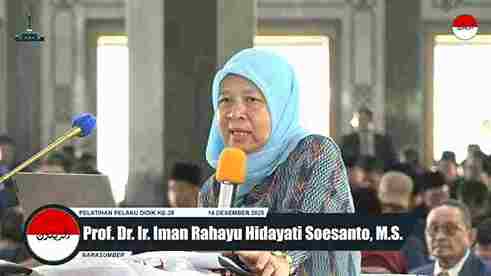
In the 28th session, held on Sunday, December 14, 2025, Al-Zaytun presented Prof. Dr. Ir. Imam Rahayu Hidayati Soesanto, M.S., an expert from IPB University, to explain the strategic role of the livestock sector in human resource development.
This presentation, which focused on the livestock perspective, specifically poultry innovation, aimed to shift the paradigm from mere quantity to high-quality, value-added food production.
Shifting the Paradigm: From Quantity to Superior Quality
Food self-sufficiency, particularly in the animal protein sector, requires not only the ability to produce large quantities, as evidenced by the Al-Zaitun chicken population of 282,000, but also a focus on product quality that provides significant added value for consumers. Prof. Imam Rahayu’s vision is to transform poultry from a mere source of protein into a functional food that contributes to the nation’s intelligence and health.
This vision is driven by the reality that Indonesia’s population will reach 281.6 million by 2025, with approximately 69.51 percent of the population in the productive age group (15-64 years old), whose quality must be improved through balanced nutrition. The primary focus is on poultry, an affordable and easily digestible source of protein, now engineered to offer health benefits beyond basic nutrition.
Omega-3 Eggs: An Innovation that Promotes Intelligence and Heart Health
Prof. Prof. Imam Rahayu is the developer of IPB’s Omega-3 Eggs, a research product that has been patented and commercialized since 2013. These eggs not only meet the need for high-quality animal protein but also function as a functional food.
Through a special feed formulation made from fish waste and vegetable protein, the resulting eggs have:
1. Higher DHA and EPA content than regular eggs.
2. Lower cholesterol levels.
3. Important benefits for fetal development, helping maintain heart health, and increasing the intelligence of toddlers and children.
Prof. Imam Rahayu explained that these eggs can be consumed by all groups, from pregnant women to the elderly, effectively transforming eggs into a tool for improving human resource quality from the upstream.
The Added Value of Poultry Meat: Anti-Carcinogenic Properties from Papua
Quality improvements are also being made to poultry meat, which is now required to meet ASUH (Safe, Healthy, Whole, and Halal) standards. Through feed innovations, Prof. Imam Rahayu has successfully created a potentially premium poultry product with additional physiological functions, namely as an anti-carcinogen, anti-mutagen, and anti-hypertensive.
The key to this innovation is the use of Pandanus Conoideus (Papua Red Fruit) oil extract dregs, which are given as a poultry feed supplement. This dregs has been proven to have the following abilities:
1. Inhibit the growth of cancer cells.
2. Reduce inflammation and lower bad cholesterol.
3. Fight viruses and bacteria.
This innovation has received two patents, demonstrating improved nutritional quality in the product and improved health profile of chickens.
IoT: Efficiency and Accuracy in Mass Production
To support large-scale animal protein production, such as Al Zaytun’s daily meat demand of 800 kg, which requires the management of thousands of birds, the implementation of IoT (Internet of Things) technology is inevitable.
IoT functions to automatically monitor and manage the cages, ensuring stable temperature, humidity, and air quality. In the context of closed-house production, IoT provides key benefits:
1. Operational Efficiency: IoT systems can precisely control the amount and timing of feed, resulting in reduced Feed Conversion Rate (FCR), increased body weight, and reduced mortality. This is crucial given efficiency challenges, where the Professor considers the harvest age of chickens at Az-Zaitun (38.3 days) too long.
2. Early Disease Detection: IoT can detect disease early, for example by monitoring hazardous methane and ammonia gases or even detecting symptoms of coryza (snoring) through sound sensors, enabling isolation measures before outbreaks threaten production.
Prof. Imam Rahayu emphasized the principle of prevention is better than cure in poultry management, and IoT is a tool to achieve this.
Strengthening Human Resources: Legacy Through Professional Certification
All innovation and technology efforts must be supported by legitimized Human Resources (HR). Prof. Imam Rahayu emphasized the need for certification competency certification encompasses skills, knowledge, and attitude.
He proposed that Al-Zaytun establish its own Professional Certification Institute (LSP), under the auspices of the National Professional Certification Agency (BNSP). This certification is important:
1. For Educators: It increases self-confidence and well-being.
2. For Students/Alumni: It serves as a Diploma Supplement (SKPI) when seeking employment abroad.
Through the synergy between feed engineering to produce smart products (Omega-3 Eggs), the use of IoT to ensure efficiency and quality, and the strengthening of human resources through certification, Indonesia has a significant opportunity to transform into a modern, productive, and globally competitive livestock sector.**
Indramayu, December 14, 2025
——-