Poet Reads 80 Years of Indonesian Independence with TISI, Isbedy Stiawan ZS: Poetic Republic, About Maintaining Aesthetic Sovereignty
JAKARTA-JAYA NEWS.COM – Literature, whether we like it or not—consciously or otherwise—has long influenced government policy and is also used in the political sphere. So, even though there’s a slogan that politics has spread throughout all aspects of national life, in reality, art—in this case, the language of literature or poetry—is often and unknowingly used by our leaders and politicians, including in the legal sphere.
“To the point where there’s an anecdote that non-poets can participate, while poets lose their diction and imagination,” said the Pope of Lampung Literature, Isbedy Stiawan ZS.
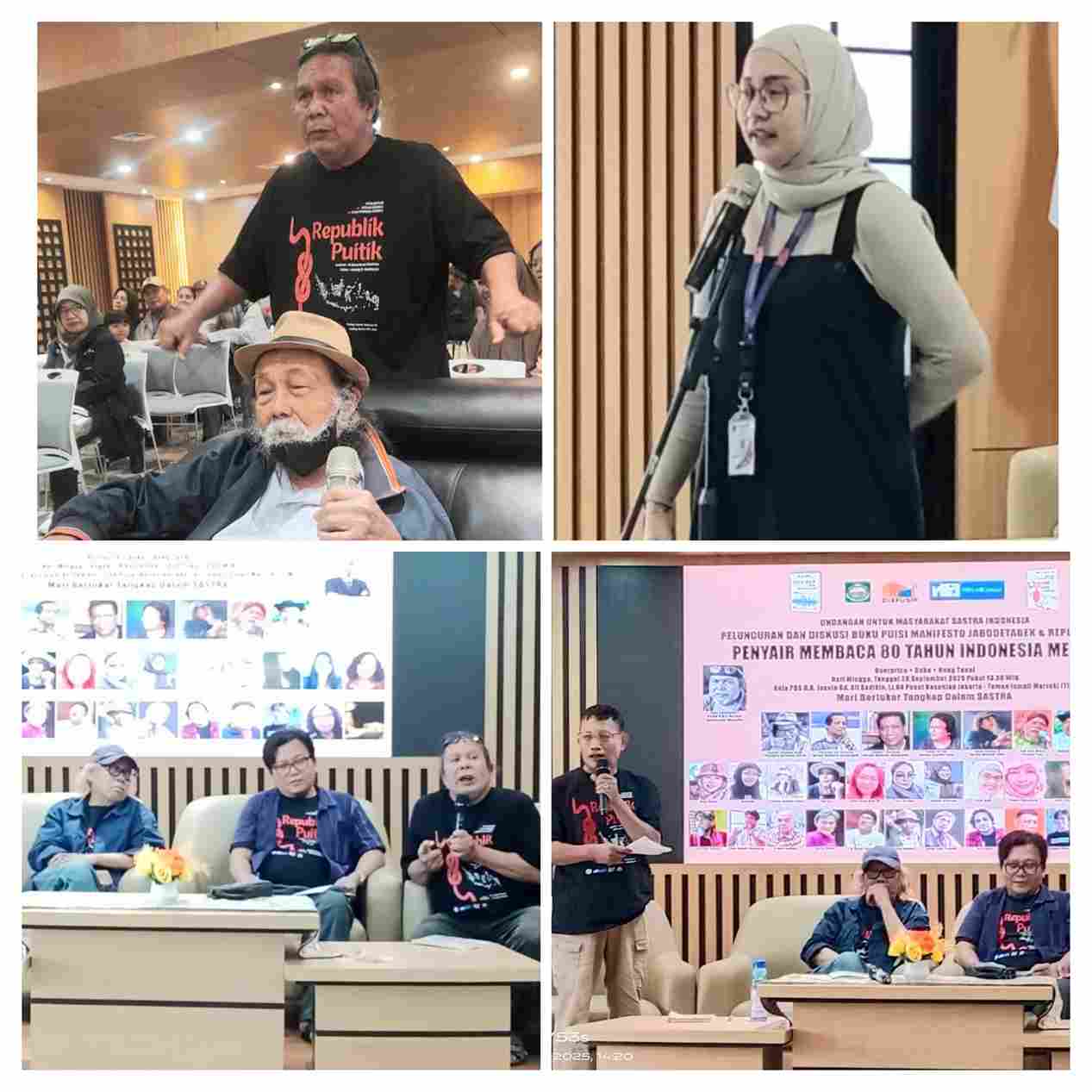
While delivering the prologue titled “Poetic Republic: The Question of Maintaining Aesthetic ‘Sovereignty'” at the launch of two poetry anthologies, REPUBLIK PUITIK and MANIFESTO JABODETABEK, at a joint literary event with the Indonesian Literature Inspiration Park (TISI) themed “Poets Read 80 Years of Indonesian Independence” at the HB. Jassin Literary Documentation Center (PDS) Hall, 4th Floor of the Panjang Ali Sadikin Building, Jakarta Arts Center (PKJ) at Taman Ismail Marzuki (TIM), Sunday afternoon (September 28, 2025).
“I think that’s what the 80 poets in this REPUBLIK PUITIK poetry anthology want to convey. The views or perspectives of these 80 poets in seeing, tasting, feeling, and enjoying an ideal government that is mutually agreed upon. Or, conversely, is REPUBLIK PUITIK merely wishful thinking and hyperbole?” he said.
The poetry reading parade and literary discussion at the launch of two poetry anthologies REPUBLIC OF PUIT and MANIFESTO JABODETABEK in the literary event “Poets Reading 80 Years of Indonesian Independence” – which was opened directly by Octavianus Masheka, Chairman of the Indonesian Literature Inspiration Park (TISI) – was attended by, among others, great Indonesian poets and writers Sutardji Calzoum Bachri (SCB), Aspar Paturusi and his wife, Halimah Munawir Anwar, Ahmadun Yosi Herfanda, Maman S. Mahayana, Jose Rizal Manua, Taufik Rahzen, Saut Poltak Tambunan, Ewith Bahar, Kurnia Effendi, Linda Djalil, Imam Maarif, Pulo Lasman Simanjuntak, Nanang Ribut Supriyatin, Yahya Andi Saputra, Guntoro Sulung II, Emi Suy, Nunung Noor El Niel, Nurhayati, Nuyang Jaimee, Rissa Churria, Wawan Hamzah Arfan, Humam S Chudori, Wig SM, and many more.
According to Isbedy Stiawan ZS, a writer and journalist who has published 50 literary books, the “Puitik Republic” seems to have spread to those in power. The language of symbolism, metaphor, and imaginative diction typically employed by writers has also been adopted by this nation’s leaders.
“Furthermore, literally, the “Puitik Republic” means a poetic state or republic that is linguistically beautiful and full of imagery. “Puitik Republic,” as I quote the explanation from the Chairman of the Indonesian Institute of Sciences (TISI), Octavianus Masheka, can also describe a leadership style that uses beautiful language, metaphors, and imagery to convey messages to the people. This style can create a more emotional and convincing atmosphere,” said the poet from Tanjungkarang, Lampung, who in 2025 published three collections of poetry entitled “Elegy for Mining,” “One Kiss, Two Hugs,” and “Waiting to Arrive.”
Poetry as a Shaper of the National Imagination
Meanwhile, in the epilogue, titled “The Role of Poetry and Poets in Indonesian Independence,” Sofyan RH Zaid states that Benedict Anderson, a historian and expert on world politics, emphasized that nations were initially imagined communities. Communities, in a biological context, are a combination of individuals of the same kind.
According to Benedict, poetry, along with other texts through the printing press, was the primary means of supporting and encouraging this ‘imagination’ to materialize.
Even though all members did not know or meet each other, the most important thing was that they shared a common imagination.
“Thus, poetry, whatever its meaning, played a crucial role in the struggle for independence of a nation state, including Indonesia. Initially, poetry played a role in shaping the national imagination. Poetry conveyed the vision of a new homeland whose people were free from colonialism and slavery,” explained the poet, born in Sumenep on January 8, 1986, and an alumnus of the Philosophy of Religion Department at Paramadina University, Jakarta.
Poetry also served as a symbolic weapon involved in the struggle, albeit indirectly. Words became the “bullets” that complemented armed struggle, whether in the form of criticism, propaganda, or inspiring fighting spirit. We know that the struggle for independence was not only a guerrilla war, but also a war of words, in which poetry served as a symbolic weapon against colonialis
The book “Repuitik Republik” (Poet Republic) itself is a monumental anthology subtitled “80+ Poets Reading 80 Years of Indonesian Independence.” This work is not simply a collection of poems, but rather a reflection of the nation’s long journey through the aesthetic lens of poets.
Poet Nanang Ribut Supriyatin, editor and moderator of the launch of the poetry anthology “80+ REPUBLIC OF PUITICS” (Poets Reading 80 Years of Indonesian Independence), stated that poetics can be described as the beauty of language and how one expresses oneself through poetic form.
Poetry, or poetic works, channel the body and soul; this is where the satisfaction of what one wishes to convey or express lies.
“Regarding the publication of the poetry anthology with REPUBLIK.PUITIK, there are several things I would like to convey. One of them is that this anthology is uncurated. I trust the contributors; they will select and submit their best Indonesian-centric poems. I hope this book will foster a relationship between us, especially in organizing future events or literary events. I apologize for only being able to include one poem; I think it fully represents the quality of this book,” he concluded.
This event was initiated by the Indonesian Literature Inspiration Park (TISI) with the support of the HB Jassin Library and Archives Office and the Jakarta Library and Archives Office.
According to TISI Chairman M. Octavianus Masheka, preparations for this event began in June 2025.
It is planned to take place on August 16, 2025, to coincide with Indonesian Independence Day.
“However, due to several technical difficulties, the event was finally held on Sunday, September 28, 2025. Despite the delay, our enthusiasm has not diminished in the slightest. In fact, this postponement has allowed the series of events to be more mature,” he said.
“In 2025—after 80 years of Indonesian independence—more than 80 poets from various generations tried to interpret the independence we have achieved. Are we truly independent? Red and white are merely colors, not the meaning that resides in the soul. To you, my country, I serve, you said,” concluded Octavianus Masheka, closing with his own poem entitled “HARI KESAKTIAN PANCASILA KATAMU” (Day of the Sanctity of Pancasila, Your Words). (***)
Contributor: Lasman Simanjuntak
—-