The Tamattu’ Hajj Dam is Deeply Spiritual in Value and Can Maximize Social and Economic Benefits for the Poor
Author : Jacob Ereste
Freelance Journalist
The IPHI National Seminar and National Working Meeting have formulated recommendations that need to be implemented, namely Hajj fiqh literacy that is responsive to the realities of Indonesian Hajj pilgrims. Among the most important is the implementation of the Tamattu’ Hajj Dam in Indonesia, as it can be an option to address food shortages in emergency situations. Therefore, the active involvement of the Indonesian Ulema Council (MUI), the Financial and Development Agency (BPKH), the Ministry of Religious Affairs, and Islamic organizations is needed to formulate fatwas and practical policies for the implementation of the Tamattu’ Hajj Dam in Indonesia, which is currently experiencing a nutritional emergency affecting 23 million children with severe stunting.
The Indonesian Hajj Brotherhood Association (IPHI) is an organization that brings together Hajj alumni from all over Indonesia. Its goal is to strengthen ties among members, improve their Islamic values after the Hajj pilgrimage, and play an active role in national development through social and religious activities.
IPHI’s Goals and Functions: IPHI aims to strengthen ties among members by providing a forum for maintaining good relationships and strengthening brotherhood after returning from the Holy Land.
This aims to improve the quality of Islam by fostering and enhancing the understanding and practice of Islamic teachings among its members.
IPHI also plays an active role in development by encouraging its members to contribute positively to various aspects of national development, both through social and religious activities. Therefore, IPHI’s organizational structure is hierarchical, from the central to the regional levels, encompassing:
Central Management (PP-IPHI)
Regional Management (PW-IPHI) at the provincial level
Regional Management (PD-IPHI) at the district/city level
Branch Management (PC-IPHI) at the sub-district level
Branch Management (PR-IPHI) at the sub-district/village level
Overseas Representatives
IPHI’s role in the community includes fostering and empowering Hajj pilgrims so they can serve as role models and pillars in efforts to improve the quality of the community and the nation. Therefore, IPHI is also active in social activities such as community service, religious counseling, and other activities that benefit the community. Some examples of activities IPHI has undertaken include alal bihalal (gatherings) and Silaturahmi (silaturahmi gatherings), religious study groups and guidance, social services, and providing humanitarian assistance. In its community empowerment program, IPHI collaborates with the Ministry of Religious Affairs in Hajj guidance. Through these various activities and initiatives, IPHI is expected to continue playing an active role in maintaining the sanctity of the Hajj, strengthening ties of friendship, and making a positive contribution to the advancement of the Indonesian nation and state.
IPHI was founded during a congress on 22-24 Sha’ban 1410 Hijriah, corresponding to March 20-22, 1990 CE. It was initiated by the Indonesian Hajj Brotherhood Organization, which is independent, adheres to Islamic faith, and is based on Pancasila.
Interestingly, IPHI has a strategic role model, serving as a platform for spiritual transformation into concrete action within society, positioning Indonesian pilgrims as social and spiritual role models.
Indonesia’s Hajj quota, which continues to increase and is fully fulfilled—resulting in a long queue waiting for their turn—was recorded in 1446 Hijri/2025 CE, reaching a total of 221,000 pilgrims.
The Tamattu’ Hajj is a mandatory fine paid by pilgrims as part of the Hajj Tsmattu’ pilgrimage. Those unable to slaughter an animal can fast for 10 days, consisting of three days in the Holy Land and seven days after returning home. The basis for the Tamattu’ Hajj is stated in Al-Baqarah verse 196: “Whoever wishes to perform a sacrifice before Hajj (in the month of his salary), then he must slaughter a sacrificial animal that is easily available. But if he cannot find (a sacrificial animal or cannot afford it), then he must fast for one day during the Hajj and seven more days after you return. These are the ten complete days.” (Al-Baqarah: 196)
This is the Hajj: not merely a ritual, but one that contains spiritual, social, and sacrificial dimensions that demand sincerity and honesty. In essence, the tamattu’ Hajj means performing a period of relaxation (unrah) before the Hajj begins, before donning the ihram garments for the Hajj. Therefore, the tamattu’ Hajj is only performed by pilgrims from outside Mecca, not those living near Mecca.
The Hajj itself can be performed in three ways. The first is called the qiran Hajj, the tamattu’ Hajj, and the infrad Hajj. The qiran Hajj is performed by combining the intention of Hajj and Umrah simultaneously. The tamattu’ Hajj is performed by
just do cheap worship, then do the Hajj. Meanwhile, the Ifrad Hajj is carried out by performing the Hajj pilgrimage first, then performing the Umrah. Even though the way of doing it is different, the harmony is still the same.
In the hadith and law of Dam Haji Tamattu’ it is stated that pilgrims perform ihram for Umrah first in Miqat. Once in Mecca, the congregation performs tawaf and so on. So Dam Haji Tamattu’ is obligatory in nature because it provides convenience in the form of slaughtering animals (goats, camels or cows or buffalo when they arrive in their hometown, Indonesia) even though the slaughter of animals has already been carried out while in the holy land.
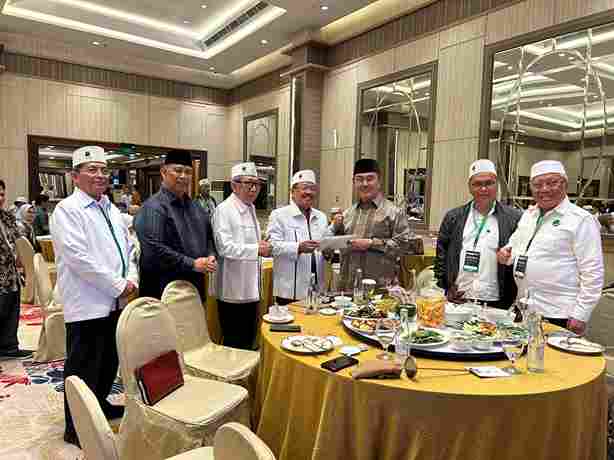
The current issue for the Indonesian Hajj Brotherhood Association, led by Erman Suparno, Chairman, Bambang Irianto, Secretary General, and Achmad Ghufron, Chairman of the IPHI Advisory Board, is that the Tamattu’ Hajj Dam will be the main topic of discussion at the 2nd IPHI National Working Meeting (Rakernas) at the Lumire Ballroom, Convention Center, Jakarta, on July 29, 2025, with all IPHI Regional administrators, including those from Papua, in attendance.
As a first step, IPHI is proposing a national and international dialogue involving the Indonesian Ulema Council (MUI), the Ministry of Religious Affairs, the Hajj Financial Management Agency (BPKH), as well as academics and Islamic jurisprudence experts from both the national and international levels, to discuss the feasibility of implementing the dam domestically.
Thus, the 2nd IPHI National Working Meeting represents a crucial opportunity to formulate policies that are not only Sharia-compliant but also provide social and economic benefits to the wider community. Based on this, the results of the IPHI seminar at the 2nd National Working Meeting will be followed up with competent and authoritative forums regarding the Tamattu’ Hajj Dam issue so that it can be implemented in Indonesia.
This approach, which is more based on the principles of maqasid sharia (Islamic law)—understanding Islamic law based on its objectives and wisdom—rather than merely in its literal form. As in the context of innovations (bid’ah), the most important essence to understand is that not everything new is deviant, as long as its purpose is beneficial and does not conflict with the basic principles of sharia. Therefore, the idea of utilizing the meat of slaughtered animals, which is abundant in Mecca, is undoubtedly a viable option for Indonesia to help address the problem of 21 million stunted and severely malnourished children. Similarly, the use of slaughtered animal meat in other countries to further its benefits, while simultaneously strengthening da’wah (Islamic propagation) and strengthening bonds of brotherhood among nations in other countries, is worthy of consideration in the context of its benefits. Of course, logistics distribution and potential waste can be further examined while maintaining the essence of worship and opening up space for ijtihad, which requires collective consideration.*
Ps. Monday, July 31, 2025
—