
By:
Dimas Aria Nabi
( Official of the Indonesian Ulema Council [MUI], Indramayu )
Some leaders are forged by history, while others are the product of engineered regulations. Gibran Rakabuming Raka is the most glaring example of the latter category.
His ascent was forced—an “accelerated” path to leadership facilitated by a change in regulations at the Constitutional Court. The Court’s ruling (No. 90/PUU-XXI/2023), which altered the age requirements for presidential and vice-presidential candidates, was not merely a legal decision; it served as the starting point for a national crisis of legitimacy. The Constitutional Court’s own Ethics Council (MKMK) concluded in its ruling (No. 2/MKMK/L/11/2023) that the decision-making process involved serious ethical violations and conflicts of interest [MKMK, 2023].
From that moment on, the foundation of Gibran’s leadership has been fractured. He is not the product of a meritocratic process—one tested through structured development, the rigorous exchange of ideas, and substantive experience in governance. Instead, he is the product of a constitutional shortcut. And history has shown that fruit ripened prematurely—”force-ripened”—will inevitably taste sour.
*A Vice President Lacking Intellectual Substance*
Following his inauguration, the public hoped Gibran would prove his mettle. Instead, his performance has only served to confirm initial doubts. He has appeared more as a figure defined by “content” (for social media) than by substantive ideas. His public image is dominated by symbolic, staged visits—handing out milk or appearing at ceremonial events—while any grand vision for the nation’s future remains virtually unheard.
When invited to engage in discussions or dialogues concerning statecraft, geopolitics, or macroeconomics, he appears faltering and unconvincing. This is not a matter of speaking style; it is a matter of depth. The simplest yet most piercing question is this: to date, which university has invited Gibran to deliver a scholarly oration?
Consider our national tradition. Mohammad Hatta was invited to speak on cooperatives and sovereignty; Jusuf Kalla on the economy; and Ma’ruf Amin on religious moderation. Universities are the ultimate testing grounds for reason.
The fact remains that institutions like UGM, UI, ITB, and Unpad have never offered Gibran a platform for a scholarly oration. The academic world understands that intellectual legitimacy cannot be artificially fast-tracked through a Constitutional Court ruling. How can a Vice President who has never been tested within an academic sphere possibly convince the public?
*Problematic Documentation: The Collapse of Administrative Foundations*
While ethical concerns may still be open to debate, the administrative issues that have now emerged are far more critical. It has recently come to light that the “Certificate of Equivalency” (a document required to validate one’s educational credentials for the Vice Presidency) is problematic.
The educational requirement stipulated in Article 169, letter (r) of Law No. 7 of 2017 concerning General Elections mandates that a candidate must have completed at least high school or its equivalent. The validity of the equivalency basis used by Gibran is now being challenged—a dispute that has led to rulings by the Constitutional Court and the Supreme Court which effectively invalidate that administrative foundation.
This is a devastating blow. It implies that Gibran’s shortcomings are no longer merely an ethical issue—as previously discussed in the context of the Constitutional Court—but now strike at the very formal requirements for his candidacy. If the administrative prerequisites are flawed, then, from a legal standpoint, the outcome of his election is also inherently flawed. In constitutional law theory, this is known as a “defect in procedure,” which results in a “defect in legitimacy” [Jimly Asshiddiqie, *Introduction to Constitutional Law*]. *The House Challenges: Resign or Be Removed*
Given this, the issue currently circulating within the House of Representatives (DPR) is both logical and constitutional: Gibran must either resign or be removed from office.
The House is not engaging in treason; rather, it is exercising the oversight function mandated by Article 20A of the 1945 Constitution. After long being accused of merely acting as a “rubber stamp” for an oversized ruling coalition, the House now has a momentum to restore its dignity through its rights of inquiry (*hak angket*), interpellation (*hak interpelasi*), and the expression of opinion (*hak menyatakan pendapat*), as stipulated under the Law on the People’s Consultative Assembly, House of Representatives, Regional Representative Council, and Regional House of Representatives (UU MD3).
Resignation is an honorable path. Being removed through an impeachment process, however, would be a painful outcome—not only for Gibran but also for the nation’s stability.
*Drama at the Palace: A Belated Plea for Sympathy*
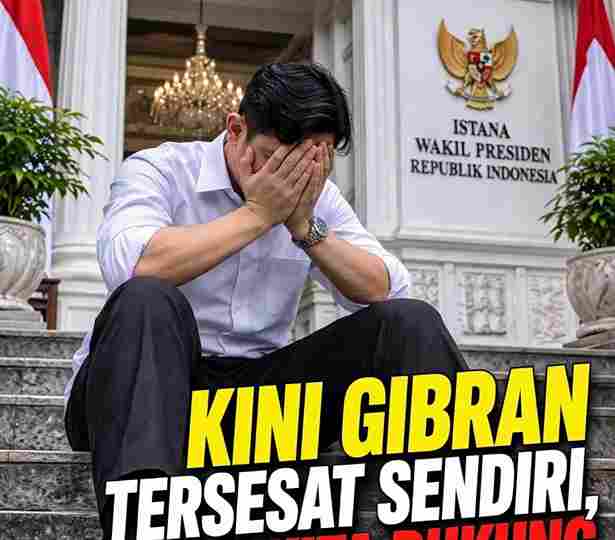
The most ironic aspect is the latest act in this drama. As talk of impeachment gained traction, Gibran signaled an intention to resign—seeking sympathy by approaching President Prabowo. Reports circulated that the President was unreceptive, instead suggesting that Gibran pursue a legal challenge through the Administrative Court (PTUN). Although the State Secretary and Yusril Ihza Mahendra later denied these claims, the public had already grasped the underlying message.
This follows an old pattern: constructing a “playing the victim” narrative—portraying himself as an aggrieved party rather than an individual who benefited from a manipulated process. If he truly wishes to resign honorably, he should not wait to be nudged toward the Administrative Court, pressured by the House, or cast aside by history.
Max Weber once noted that a leader’s legitimacy stems not only from formal legality but also from rational public acceptance [Weber, *Economy and Society*]. When the foundation of one’s legality is fractured and rational public acceptance has vanished, what is left to defend?
*Conclusion: Surrendering to Save the Nation*
Gibran must realize that the time has come. Surrendering does not equate to defeat. In this context, surrendering is an act of saving the constitution to safeguard the integrity of the Constitutional Court and the Supreme Court, and to rescue the nation from a protracted crisis of legitimacy.
Resigning is more honorable than being forced out. Resignation is a chivalrous act—one that history will remember as the courage to acknowledge systemic flaws. Clinging to power amidst all this drama will only deepen the nation’s wounds.
Give in, Gibran—before history forces you to surrender.
Indramayu, November 12, 2026
—–


