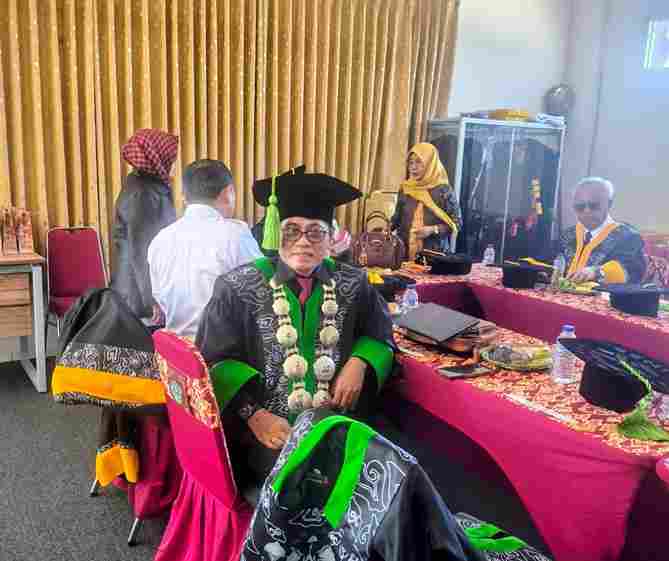
(Rector of Al-Amin Islamic Institute Indramayu and Postgraduate Lecturer at UIN Siber Syekh Nurjati Cirebon)
INDRAMAYU,JAYA-NEWS.COM – There is the most painful irony in democracy: the people give their votes to change their destiny, but some politicians turn promises into a tool to gain power.
Before being elected, the people are the goal of the struggle. After coming to power, the people are often only spectators asked to understand the situation.
A Joke That Strips Power Naked
Gus Dur, with his distinctive humor, once quipped: There are 4 characteristics of nations in the world. First, little talk, little work (Nigeria, Angola). Second, little talk, much work (South Korea, Japan). Third, much talk, much work (America, China). Fourth, much talk, little work (Pakistan, India).
When asked which category Indonesia belongs to, Gus Dur answered: It cannot be included in any of the four categories. Because in Indonesia, what is talked about is different from what is done.
Behind the humor lies serious criticism of the political elite. Our problem is not a lack of hard work, but a failure to maintain loyalty between words, decisions, and implementation.
Promitto Ergo Sum: I Promise, Therefore I Am
If Descartes is famous for cogito ergo sum. I think therefore I am, on the political stage it changes to promitto ergo sum. I promise therefore I am.
Hannah Arendt (1958) in The Human Condition places action and speech as an important part of human life in public space. In politics, both should reinforce each other. Words without action lose credibility.
The problem is not politicians who are good at talking, but those who make the ability to talk a substitute for the obligation to work. Speeches are treated as achievements, social media posts as evidence of devotion, even though documentation is not a measure of policy success.
Mandate Is Not Merchandise
In Islamic perspective, QS. Ash-Shaff : 2-3 reminds us not to say what we do not do. The people’s mandate is not a blank check.[61]
A responsible leader does not always have to succeed. He may face budget limitations or policies that do not reach targets. But he must honestly explain obstacles, show evidence, and correct mistakes.
What deserves harsh criticism is when failure is disguised as success, criticism is considered hostility, and the people are continuously asked to be patient without a clear measure of time and results.
The People Should Not Continue To Be Victims of Rhetoric
Democracy loses its meaning if the people are sovereign only during voting, then lose the power to demand accountability afterward.
The measure of leadership must be shifted from popularity to integrity, from the number of promises to measurable achievements, and from the grandeur of ceremony to changes felt by the community.
The press, universities, civil society, supervisory institutions, and citizens must ensure that every political promise can be tested through indicators, deadlines, budget transparency, and open evaluation.
In the end, Gus Dur’s joke reminds us that the nation’s crisis is not only an economic or legal crisis, but a crisis of character in power.
A true leader is not measured by how melodiously he promises, but by how real he works and how brave he is to be accountable for the results.
The people do not elect leaders to hear the same promises every five years. The people elect them so that their lives truly change.
Indramayu, October 17, 2026
——–