From the Pendopo to the Palace: Three Leaders, One Silence
By Ali Aminulloh
Indramayu, July 15, 2026
There’s an interesting scene in the leadership journey of the people of Indramayu today. From the Indramayu Regency Hall, the Pakuan Building in West Java, to the Merdeka Palace in Jakarta, the three leaders who oversee the people of Indramayu all live their lives without wives. Is this mere historical coincidence, or is solitude truly choosing its own path to accompany power?
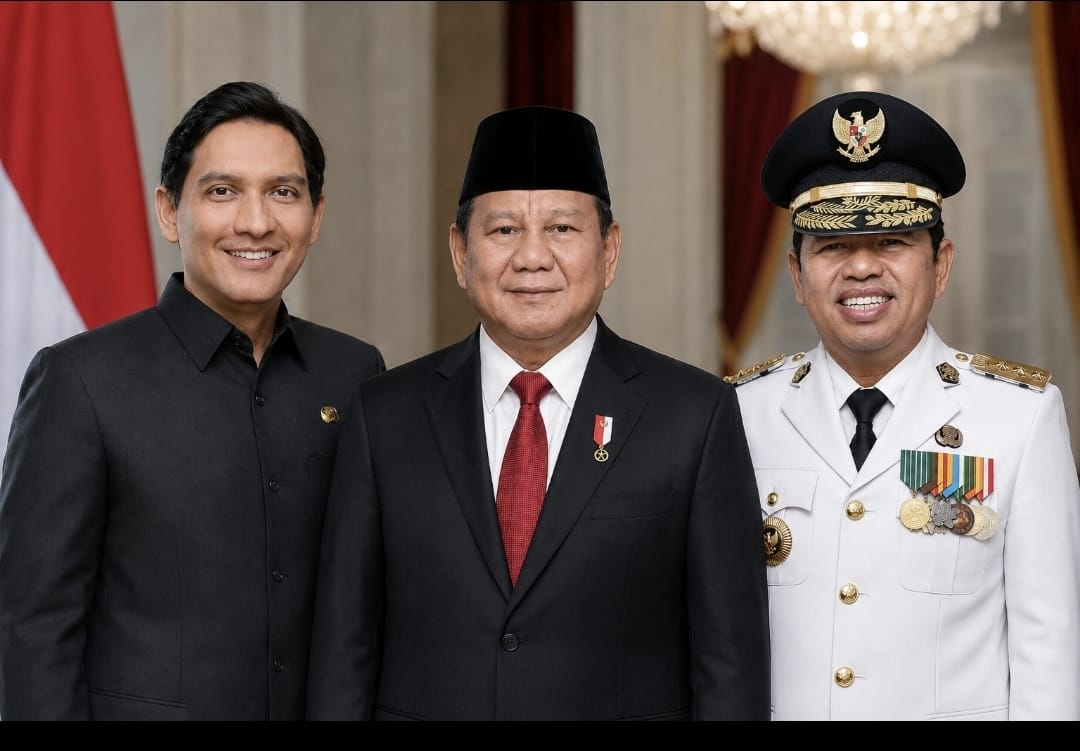
The people of Indramayu may have a story not often found in other regions. At the regency level, they are led by Regent Lucky Hakim. At the provincial level, Indramayu is under the leadership of West Java Governor Dedi Mulyadi. Meanwhile, at the national level, the Indonesian people are led by President Prabowo Subianto. All three now occupy interconnected levels of leadership: regional, provincial, and national.
However, the term “single” needs to be used appropriately. All three are not single in the sense of never having started a household. They have been married and have their own family journeys. Lucky Hakim officially divorced Tiara Dewi in 2017. Dedi Mulyadi officially divorced Anne Ratna Mustika following the Supreme Court’s cassation ruling in 2023. Meanwhile, Prabowo Subianto was previously married to Siti Hediati Hariyadi, also known as Titiek Soeharto, and is currently carrying out presidential duties without a partner as First Lady.
Does this make them different as leaders?
Of course, marital status is not a measure of one’s ability to lead. Leadership is not determined by whether or not someone has a partner, but by the courage to make decisions, the ability to listen to the voice of the people, the steadfastness in upholding trust, and the willingness to put the interests of the people above personal gain.
However, the similarities in the personal journeys of these three leaders remain compelling to ponder. Behind the bustling stage of power, a leader often walks in silence. After the cameras are turned off, the meeting ends, the aides leave the room, and the people return to their homes, a leader is once again confronted with himself.
Therein lies the true test of power.
Solitude can be a space for reflection, but it can also become a burden. It can foster clarity of thought, but it can also create a distance from society. Therefore, leaders who live without family support need a healthy social circle, honest advisors, friends who are willing to remind them, and a community that not only praises them but also dares to criticize them.
Were these three inspired by great historical figures who also lived single lives? There is no factual basis for such a conclusion. The choice and journey of marriage are personal matters, not always related to political views or historical inspiration. However, the lives of several great figures do demonstrate that a person can devote enormous energy to science, struggle, the nation, or humanitarian service when their life is no longer centered on domestic matters.
However, living alone does not automatically make someone greater. Similarly, family life does not diminish one’s capacity to serve. Many great leaders thrived with the support of a partner and family. Many others walked alone. What is decisive is not the circumstances of the marriage, but how a person transforms those circumstances into moral strength.
For the people of Indramayu, this phenomenon should not be merely a subject of political jokes or a discussion of personal lives. There is a deeper message to be read. When the Regent, Governor, and President are all without their wives, the people can expect their time, attention, and energy to be increasingly directed toward public service.
However, this hope also gives rise to greater demands.
Not having a partner does not mean not having a family. A leader has a much broader family: farmers waiting for fertilizer, fishermen facing the waves, teachers educating those with limited resources, small traders keeping the economy running, children needing quality schools, and the poor awaiting the presence of the state.
The Pendopo is not simply the official residence of the Regent. The Pakuan Building is not merely the residence of the Governor. The Palace is not merely the seat of presidential power. All three are houses of service where the voice of the people should be heard and solutions to the suffering of the people sought.
Therefore, what is special about the people of Indramayu is not merely that their three main leaders are living without partners. The specialness lies in the historical opportunity that is now opening up: to see whether these leaders capable of transforming personal solitude into expansive devotion.
The people certainly don’t need leaders who are strong enough to stand alone. They need leaders who are willing to stand with them.
Because ultimately, history won’t ask who accompanied a leader when he was at home. History will ask: who did he accompany, defend, and ensure the well-being of when he held power?**
——-