By: Ali Aminulloh
In just a few days, Muslims will celebrate their victory in a way that actually leaves a question mark. “When is Eid al-Fitr?” A sacred occasion for which preparations are so extensive, involving the state, society, and all elements of life, yet the timing itself still hangs in the balance of uncertainty. This isn’t just a technical matter. It’s a matter of awareness.
For Indonesian Muslims, Eid al-Fitr is a national event. Long before, people start saving for the holiday. Police officers conduct Operation Ketupat. The government conducts market inspections to maintain food security. The industrial world moves quickly: food, clothing, and transportation. Roads are being repaired, free homecoming programs are being launched, airlines are adding flights, and PT Kereta Api Indonesia (KAI) is improving its services. Everything is carefully planned, measured, and certain.
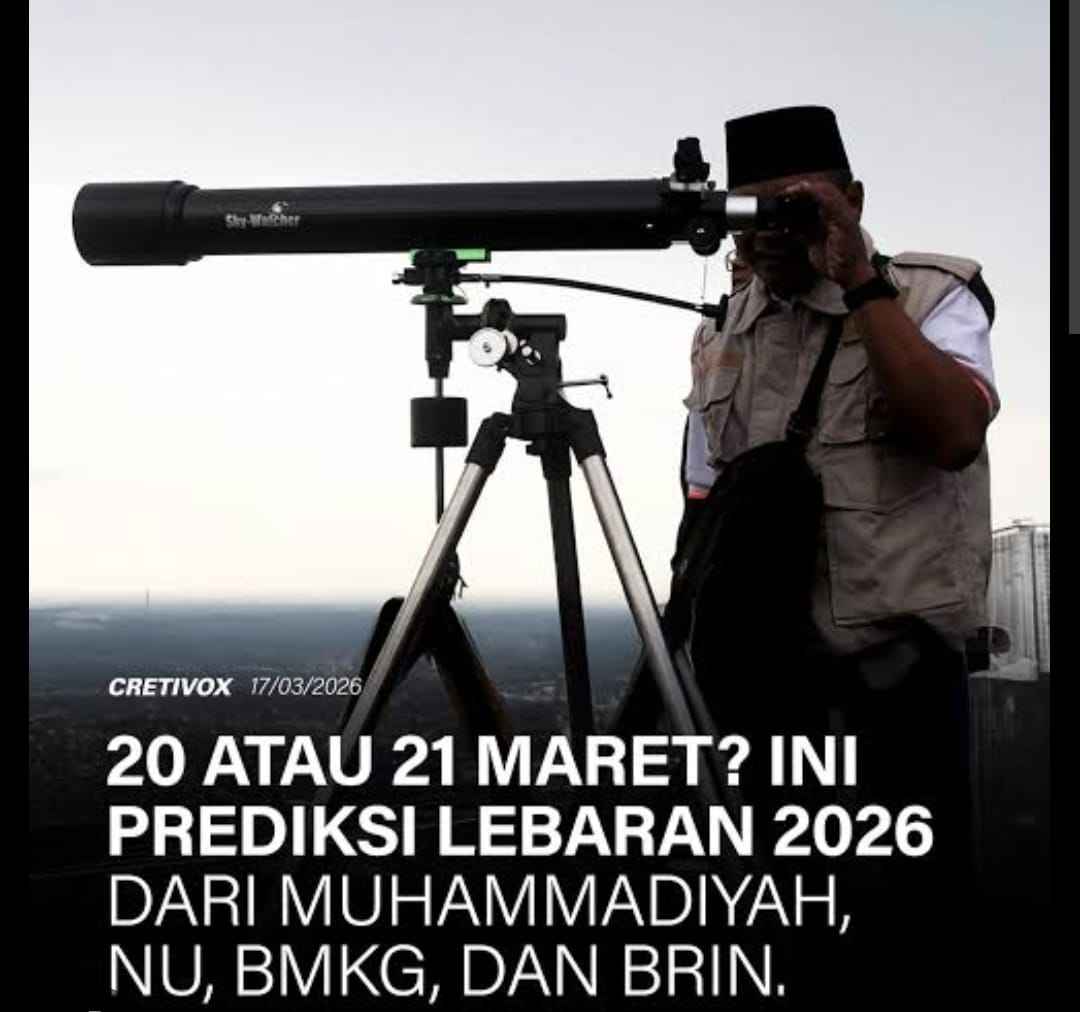
But amidst all this certainty, one thing remains uncertain: when exactly Eid al-Fitr will be celebrated. We know it falls on the 1st of Shawwal. But the fundamental question remains the same every year: when does the 1st of Shawwal fall? The answer often only comes through the isbat (time-finding) meeting, often just one day before the Eid al-Fitr holiday. An irony that keeps repeating itself.
In Indonesia, this problem is made even more apparent by the existence of two methods for determining the beginning of the Hijri month. The hisab method, used by Muhammadiyah, provides certainty well in advance based on precise astronomical calculations. Meanwhile, the rukyat method, commonly used by Nahdlatul Ulama, relies heavily on natural conditions, so certainty is often only obtained at the last minute. The government has tried to combine the two through isbat meetings, but the result remains the same: people wait, guess, and even prepare for two possible outcomes.
The question is simple, yet fundamental: why does the technical aspect of time trump the substance of worship itself?
The Quran provides clear direction. In QS. Al-Baqarah verse 185:
“Whoever among you witnesses the month, let him fast it.”
In QS. Al-Baqarah verse 189:
“يَسْأَلُونَكَ عَنِ الْأَهِلَّةِ ۖ قُلْ هِيَ مَوَاقِيتُ لِلنَّاسِ وَالْحَجِّ”
“They ask you about the crescent moon. Say: it is a timer for humans…”
And in QS. Al-Isra verse 12:
“And We have made the night and the day as two signs…”
All of this confirms that Islam is built on order, certainty, and ease for mankind. But deeper than that, there is one thing that is often forgotten: the purpose of worship is the welfare of mankind.
Fasting is not just about enduring hunger and thirst. It is an exercise in restraining the ego. Restraining personal desires. Controlling lusts. Even further: subduing the ego of the group. Fasting is a process of returning to one’s nature: becoming a clearer, more humble person, and more ready to unite.
But ironically, when Ramadan ends, the ego reappears in a different form. The ego of method. Group egos. Individual egos of righteousness. It’s as if the technicalities of timing are more important than the unity that should arise from worship itself.
This is where we need to be honest: do we truly understand the purpose of fasting?
If fasting is successful, then Eid al-Fitr should be a moment of unity. Not of difference. Not of confusion. Not of endless debate.
From the perspective of Shaykh Al Zaytun’s trilogy of awareness: philosophical, ecological, and social awareness, this issue becomes increasingly clear.
Philosophically, sharia exists for the benefit of all, not for complexity. If old methods create uncertainty, then what must be maintained is the goal, not merely the method.
Ecologically, the universe operates according to definite laws. The orbits of the moon and sun are never wrong. Science is the way humans interpret that certainty. Ignoring technology means ignoring the clear verses of Allah’s covenant.
Socially, the impact is real. Differences in Eid break up moments of togetherness. Families can celebrate on different days, communities can become confused, and even the national atmosphere can become disjointed. After all, Eid al-Fitr is a symbol of unity.
So, how long will we allow this to happen?
Will we continue to maintain differences in the name of method, while the essence of worship, namely public welfare and unity, is neglected?
In this era, technology has reached extraordinary levels. The position of the moon can be calculated with high accuracy. It no longer depends on the weather or limited visibility. Certainty exists. It just depends on whether we choose to use it or not.
Sharia was never intended to make things difficult. It came to make things easier, unite, and bring goodness to humanity. So if uncertainty still exists today, perhaps what needs.Let us reflect not on the text, but on how we understand and practice it.
Because ultimately, true victory on Eid is not merely about successfully enduring hunger for a month, but rather about subduing ego, both personal and group.
And if that is truly achieved, then Eid al-Fitr will not only be a day of victory, but also a day when this nation returns to its natural state: unity.**
Indonesia, March 18, 2026
——