The Solid Foundation of Tanah AIR Polytechnic: Establishing Confidence with Spun Piles
(Supervision Report, Monday, December 15, 2025)
By Ali Aminulloh
The sky above the construction site of Tanah AIR Polytechnic (Al Zaytun Indonesia Raya) in Gantar Village, Indramayu, West Java, seems to be a silent witness to a civilizational process underway. This is not simply the erection of a building, but the laying of the foundation for the nation’s future. And beneath the busy construction work, there’s an interesting story about the foundation choice that supports this grand dream: Spun Piles.
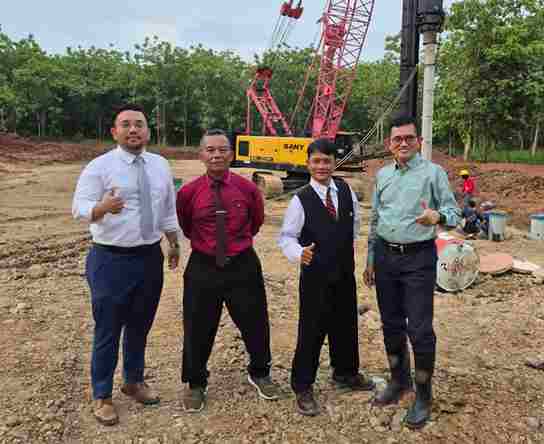
On Monday, December 15, the Supervision Team, the “Isnin” group, returned to its third week of supervision duty. Their focus was divided on three crucial tasks: backfilling the floor foundation with gravel, relocating teak trees, and, most strikingly, the driving of the Spun Piles, the giant “earth nails.”
This week’s milestones for the foundation backfilling: 1,715 m³ of gravel has been laid, 15 teak trees have been carefully moved to the base site, and a total of 14 spun piles are now firmly embedded, six of which were driven this Monday. These figures speak volumes, but behind every meter achieved lies a much deeper philosophy.
Getting to Know the Giant ‘Earth Nail’
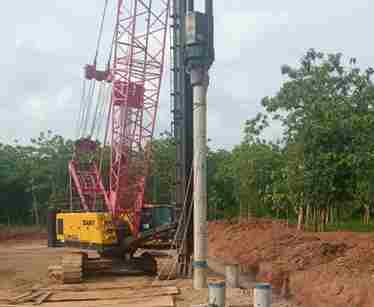
What is a spun pile? To the layperson, it may sound unfamiliar. A spun pile is a type of deep foundation made of precast concrete in the shape of a hollow cylinder. It serves as the structural backbone, tasked with supporting the massive weight of the building and preventing future land subsidence.
The installation process was no joke. At one point, based on the results of the Sondir (geotechnical testing), the required depth of hard soil was 17 meters. Because precast spun piles are available in standard sizes, each point had to be connected. To achieve the 17-meter target, two spun piles were used: one 12-meter long as the main nail, connected to a 6-meter long rod. The total length was 18 meters. These were driven exactly 17 meters, leaving 1 meter protruding above the surface for connection to the superstructure.
This choice of length and configuration was not a matter of guesswork, but rather the result of in-depth scientific data analysis. Sophisticated tools such as the SPT (Standard Penetration Test) and CPT (Cone Penetration Test) or Sondir were used to “read” the strength and characteristics of the subsurface soil.
Advantages and Challenges of Spun Piles
So, why choose spun piles? Using spun piles is a highly scientific choice due to a number of significant advantages. First and foremost, they have a very high load-bearing capacity, making them ideal for supporting massive vertical structures like campuses. Second, spun piles are manufactured in a precast factory, ensuring guaranteed and uniform quality due to the process being under strict quality control. Furthermore, due to its relatively quick fabrication and on-site installation time, it can accelerate the overall construction schedule. The central cavity can also be filled with other materials, providing better corrosion resistance and long-term structural durability.
However, this option certainly comes with challenges and cost implications. One of the main drawbacks is the initial cost, which tends to be higher than other types of foundations, given the use of high-quality precast materials, the extensive logistics of delivering spun piles, and the need for specialized heavy equipment, such as pile drivers, for installation. Secondly, the spun pile driving process can generate significant vibration and noise, an aspect that must be carefully managed, especially if the project site is close to a sensitive area. Finally, the project must ensure adequate accessibility for long spun pile trucks and heavy equipment, a crucial logistical consideration.
Safety Above All
The use of spun piles by the Indonesian Polytechnic (Polyteknik Tanah Air) underscores the primary focus of this development. Publicly, the primary focus of the development in the Al Zaytun area is scientific and considers all possibilities.
The foundation was chosen not based on the cheapest option, but rather on the safest and strongest. This decision demonstrated an extraordinary level of caution, rooted in the belief that every building must be able to stand firmly against time and the challenges of nature. The choice to use this tested and strong foundation, despite the risk of higher costs, was based on a noble philosophy: “Human safety is far more valuable than all that,” he firmly held.
This philosophy was reflected not only in the choice of spun piles, but also in every stage of construction, from accurate soil investigations to precise pile driving. This was a construction based on scientific calculations, not speculation.

Epilogue: Planting Faith, Reaping the Future
When heavy equipment roared, driving concrete cylinders 17 meters deep, it wasn’t just the sound of construction. It was the sound of instilling faith. Faith that the education provided at the PTA must stand on the most solid foundation, unshaken by the type of soil or the burden of expectations.
The Tanah Air Polytechnic doesn’t just build durable buildings. They instill the value that every step, even those hidden underground, must be carried out with precision, responsibility, and the highest scientific standards.
In every spun pile installed, a promise of quality and safety is embedded. This is the story of how a precast concrete foundation became a symbol of steadfast vision, where cost is secondary to safety and future sustainability.***
Indramayu Indonesia, December 16, 2025
——-