Indonesia’s Kitchen of the Future: How Science, Technology, and Innovation Ensure Food Sovereignty
By: Dr. Ali Aminulloh, M.Pd.I., ME
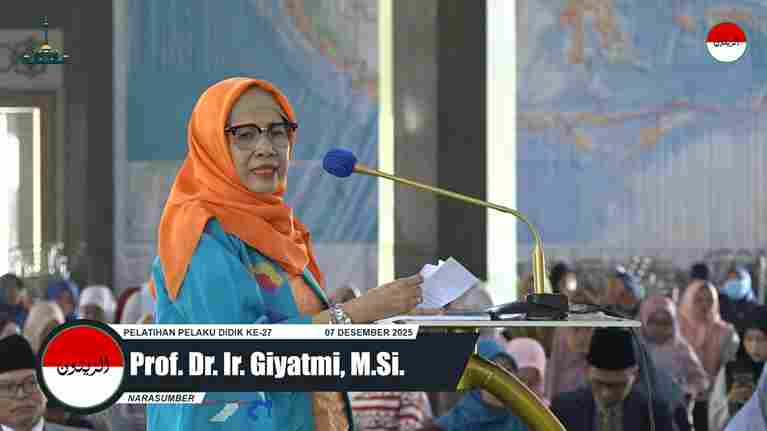
On Sunday, December 7, 2025, amidst the 27th week of the Al-Zaytun Student Training, the air was filled with a transformative spirit. The event, themed “Towards a Revolutionary Transformation from Boarding Schools to Modern Education in the 21st Century and 100 Years of Indonesian Independence,” emphasized that the nation’s future is built on a foundation of knowledge. Strengthening LSTEAMS (Law, Science, Technology, Engineering, Art, Mathematics, and Spirituality)-based education, Al-Zaytun presented a keynote speaker: Prof. Dr. Ir. Giyatmi, M.Sc., Rector of Sahid University and Professor of Food Technology, who thoroughly explored the crucial role of her knowledge in the topic “The Role of Food Technology as a Pillar of National Food Security.”
Embracing Soekarno’s Mandate: From Mere Sufficient to Sovereignty
Our Proclaimer, Ir. Soekarno’s 1952 statement that “The life and death of our nation in the future will depend on the question of food supplies,” feels increasingly relevant. For Indonesia, the issue of food is no longer merely a matter of availability—often patched with imports—but rather a matter of honor and independence.
We must shift from mere Food Security (where our stomachs are full, regardless of the source) to true Food Sovereignty. Sovereignty means we are able to stand tall and determine the fate of our own stomachs, utilizing all the natural potential we are blessed with. Ironically, amidst the wealth of land and sea, we still face chronic problems: malnutrition and unequal access to food.
Uncovering Local Treasures: Moringa and Tempeh, the Saviors
Indonesia is a food paradise. Long before rice, our ancestors mastered cassava, sago, corn, sweet potatoes, and sorghum. This is a limitless carbohydrate reserve ready to be processed and diversified.
The same goes for protein. Besides the potential of marine fish (as envisioned by Al-Zaytun through a large fishing fleet) and freshwater fish, we have the champions of plant-based protein: nuts, mushrooms, and, most fantastically, moringa leaves. Moringa, a local, wild-growing superfood, is packed with protein, vitamins, and anti-inflammatory compounds—a free health boon. And of course, there’s tempeh, a fermented heritage that is the perfect functional food, protecting the body with its amino acids and isoflavones.
All this richness is complemented by countless spices. Ginger, turmeric, cloves, and other spices are not just flavorings, but also top sources of antioxidants that make our food function as natural medicine.

The Silent Crisis Behind the Plate: The Threat of Waste and Stunting
Despite its food riches, this country is facing a silent crisis. First, high post-harvest loss. Much of our harvest is wasted during the production and handling stages due to inadequate infrastructure and technology. Second, we are the kings of food waste. Imagine, Indonesia throws away between 115 and 184 kilograms of food per capita every year! A quarter of our daily calorie potential is lost. Food waste now constitutes the largest component of total national waste.
On top of this material loss, we are also hit by the triple burden of malnutrition: some are stunted (short), others are obese, and many are micronutrient deficient. This challenge is exacerbated by climate change, land conversion, and the preference for fast food high in sugar, salt, and fat.
The Future of Food at the Edge of Technological Innovation
Food technology presents a revolutionary solution. Its role is to transform challenges into opportunities through three strategies: diversification, processing innovation, and digitalization.
Innovation has taken us to unimaginable limits. We now know plant-based meat analogues, which allow us to enjoy the texture of meat without relying on large farms, and are far more resource-efficient. In fact, scientists are now harvesting cultured meat—meat grown from animal cell cultures in a laboratory—a breakthrough that could drastically reduce greenhouse gas emissions.
On the preservation side, technology is also getting smarter. From High Pressure Processing (HPP), which preserves food without destroying nutrients with heat, to nanotechnology that uses microencapsulation to protect sensitive vitamins from being destroyed during processing. All of this is supported by smart packaging that can detect and fight bacteria in real time.
Not to be outdone, Artificial Intelligence (AI) is now infiltrating our kitchens and warehouses. AI helps sort produce, optimize supply chain logistics, and predict consumption trends, all to minimize waste and maximize efficiency.

Dispelling Fears: The Science Behind
Processed Foods
Naturally, the question arises: what about ultra-processed foods?
Does food technology only produce unhealthy food?
The answer is that the role of food technology is to ensure safety. In an archipelagic country like Indonesia, not everyone can enjoy fresh vegetables every day. The food industry exists to provide food that is long-lasting, safe, and nutritious—a logistical necessity.
Every legal food product must pass the strict regulations of the Food and Drug Authority (BPOM), which refer to the international Codex standards. Food technologists implement quality control systems such as HACCP to ensure public health. The use of formalin or other prohibited substances is a criminal act by irresponsible individuals, not a reflection of food science.
Even in heating or sterilization processes, scientists work with precision calculations (commercial sterilization). The goal is not to eliminate nutrients, but rather to kill harmful microbes and extend shelf life, while minimizing the potential for nutritional damage.
Reflections for a Prosperous Indonesia
Food technology is an investment in lasting independence. It is the key to integrating the natural wealth of the archipelago with the demands of 21st-century efficiency.
If we successfully utilize science—encouraging diversification of local potential (sorghum, moringa), promoting processing innovation, and implementing digitalization in the supply chain—we will be able to overcome the food waste disaster and the nutritional problems that hamper the quality of our human resources.
Food sovereignty is the foundation of national sovereignty. With the support of science and spirituality (LSTEAMS), Indonesia will not only be able to feed its 280 million people independently, but also provide healthy, safe, and nutritious food for every individual. This is the sure path to an Indonesia that stands tall, productive, and truly prosperous.
Indonesia, December 8, 2025
———