Whose Responsibility is Public Street Lighting?
By: Ali Aminulloh
Some journeys are more than just moving the body from one place to another. They shift consciousness: about life, about responsibility, and about who should ensure safety on the roads we travel together.
On March 28, 2026, that journey began with a sense of emotion. I was taking my third child, Zulfan Tamami Ali, back to Japan. As I departed for the airport, the journey seemed smooth. The toll road was quiet because the one-way system for returning home for Eid was in effect. However, this smoothness didn’t last long. As we approached the inner-city toll road, congestion began to be felt: traffic piled up, as if reminding us that the roads always have an unexpected side.
The return journey presented a more bittersweet story. Upon exiting Cikampek Utama, vehicles were directed off the toll road and onto the arterial road. Not by choice, but because the one-way traffic system was still in effect. At the Jomin intersection, access was closed again. Vehicles were forced to detour to Karawang, then onto the busy Pantura route.
Dusk turned to night. And that’s where this journey turned into a test.
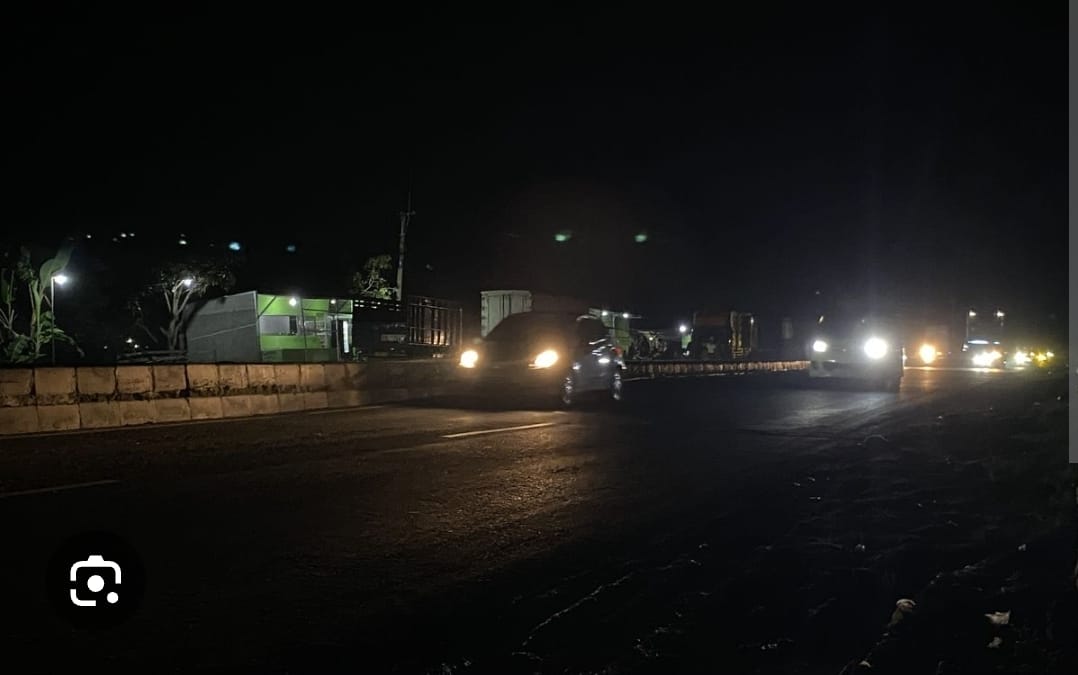
Along the Pantura road from Ciasem to Sukra, darkness enveloped the road. Not a single streetlight was on. The only light came from passing vehicles: dazzling, distracting, and even threatening. Trucks passed with dim lights, and many motorcycles barely lit. The sidewalk divider was barely visible. Several times, my vehicle nearly collided with it. Exhausted after a long journey, my concentration was tested to its limits.
This isn’t just a personal experience. It’s a vivid portrait of the risks that continually recur.
Data speaks louder than stories. Nationally, in 2023, there were 146,854 traffic accidents recorded in Indonesia, one of the highest figures in recent years. Within the Pantura region itself, a small illustration can be seen in Situbondo Regency, one of the main routes along the Pantura route. There were 544 accidents in 2023 and 399 in 2024, with 111 fatalities.
At other points along the Pantura (North Coast) route, such as the Brebes section, research shows 113 accidents occurred between 2020 and 2024, resulting in dozens of fatalities. These accidents were triggered not only by human error but also by infrastructure factors: potholes, faded road markings, damaged signs, and a lack of safety facilities.
This means the problem isn’t just the drivers. The problem also lies with the system, which isn’t fully in place.
In that context, the dark road I passed that night wasn’t simply a matter of dead lights. It was a symbol of repeated negligence. Because on a busy route, on a vital national road, the lack of lighting isn’t just a lack of facilities, but a real threat to human life.
Yet, the public never fails to pay. Street lighting taxes (PJU) are still collected, and electricity bills are still paid. But when the roads are dark, a fundamental question arises: where is the state’s presence?
By law, national roads are the responsibility of the central government through the Ministry of Public Works and Public Housing. But does that mean regional governments can turn a blind eye? Can public safety be separated simply by administrative lines of authority?
This is where criticism must be delivered, not with anger, but with awareness.
Shaykh Al Zaytun, A.S. Panji Gumilang, initiated a trilogy of awareness: philosophical, ecological, and social. These three awarenesses should be the foundation of every public policy.
Philosophical awareness reminds us that every road is built for humanity. Therefore, when roads are left dark and dangerous, what is being neglected is not just facilities, but human values themselves.
Ecological awareness demands the creation of a safe and decent environment. Damaged infrastructure, potholes, and outages are signs that this balance has not been achieved.
And social awareness affirms that safety is a shared responsibility. The central government, local governments, and the community are all bound by the same moral responsibility: protecting life.
The night journey finally ended. The streetlights began to come on as we entered the Patrol Sukra border, as if providing belated relief.
But the question still hung:
How many more accidents must occur on the Pantura road?
How many lives must become statistics before the lights are truly turned on?
If this darkness continues, it won’t just be street lighting that will be lost.
But also the light of our consciousness as a nation.**
Indonesia, March 30, 2026
———