Can Boarding Schools Break Down the Barriers of Poverty?
By Dr. Ali Aminulloh, S.Ag. M.Pd.I. ME.
We often imagine economic progress born from the hum of factory machines or the coolness of skyscrapers. However, what if the secret of a Golden Indonesia is hidden behind the simplicity of boarding schools? A place where time seems to slow down to shape humans, but is actually accelerating the most rapid leaps in civilization. This is the paradox of our education: to create a competitive, modern society in the 21st century, we need to return to the roots of intensive, character-building education.
Amidst the heated discussion about digitalization, Al-Zaytun Islamic Boarding School remains steadfast. This institution consistently transforms itself through ongoing training for its students. With the overarching theme “Revolutionary Transformation of Boarding Schools Towards a Modern Indonesia in the 21st Century and 100 Years of Indonesian Independence,” this training is not merely a routine activity, but a long-term intellectual endeavor.
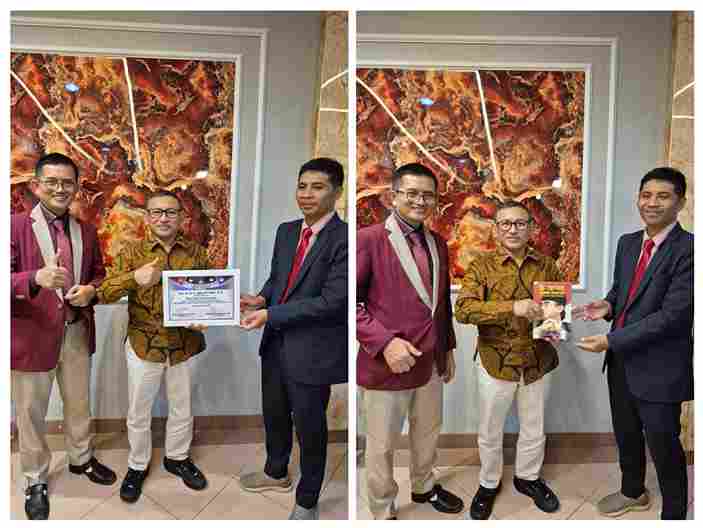
On Saturday, January 3, 2026, the atmosphere at the AL-Zaytun Campus was electrifying once again. The training, now in its 31st session, featured a figure capable of examining education from an unconventional perspective: Prof. Dr. A. Jajang W. Mahri, M.Si., a Professor of Islamic Economics and Business from the Indonesian University of Education (UPI) in Bandung.
Education: The Hidden Engine of Growth
In his presentation, Prof. Jajang delivered a stirring message: “Great nations are not born solely from numerical growth, but from the quality of their people.” For him, economics is not just about GDP or foreign investment. Economics is about equitably educated people.
He expressed concern about inequality. Home education often serves as a “hidden curriculum” that perpetuates poverty. Children from wealthy families receive extraordinary stimulation at home, while children from poor families struggle even to learn. This is where boarding schools, or Islamic boarding schools, come in as a savior.
“Boarding schools are the great equalizer,” said Prof. Jajang. With the boarding school system, the state (or institution) takes over the environmental role of ensuring that every child, regardless of economic background, receives equal quality nutrition, discipline, and intellectual stimulation 24 hours a day.
Five Pillars to a Golden Indonesia
Prof. Jajang did not simply come with a theory; he proposed five pillars of superior schools that must be the foundation for Indonesia’s 100th anniversary of independence. These pillars include quality and excellence, character and morals, regional equity, social inclusiveness, and a strategic partnership between Islamic boarding schools and the state.
He praised how Islamic boarding schools, including Al-Zaytun, have preserved knowledge and morals when the formal education system often loses its core values. Islamic boarding schools are no longer merely places for religious learning in the narrow sense, but rather laboratories of civilization that prepare individuals to lead and serve.
Learning from Islamic Boarding Schools
While development theory often focuses on ways to escape poverty, boarding school education provides concrete evidence of how a nation can rise. Prof. Jajang emphasized that the state does not need to seek new, unfamiliar models; The country has much to learn from Islamic boarding schools.
An educational philosophy that humanizes people, organically fosters discipline, and instills social responsibility is the key to breaking the chain of structural poverty.
Closing his session, the Professor offered a profound reflection. If we dare to invest significantly in quality boarding school education today, then “Golden Indonesia 2045” will no longer be just a political slogan. It will be the tangible fruit of the civilizational endeavors being woven in classrooms and dormitories today.
History will likely record that Indonesia’s great economic leap did not begin with the stock market, but rather when the country began to learn from the sincerity and discipline of Islamic boarding schools. And Al-Zaytun, through this 31st training, has just confirmed its position as the locomotive of this transformation.**
Indramayu, January 4, 2026
——